Saturday, October 31, 2020

For all the saints


Scripture. Revelation 7:9-17.  New Revised Standard Version

9 After this I looked, and there was a great multitude that no one could count, from every nation, from all tribes and peoples and languages, standing before the throne and before the Lamb, robed in white, with palm branches in their hands. 10 They cried out in a loud voice, saying,

“Salvation belongs to our God who is seated on the throne, and to the Lamb!”

11 And all the angels stood around the throne and around the elders and the four living creatures, and they fell on their faces before the throne and worshiped God, 12 singing,

“Amen! Blessing and glory and wisdom

and thanksgiving and honor

and power and might

be to our God forever and ever! Amen.”


13 Then one of the elders addressed me, saying, “Who are these, robed in white, and where have they come from?” 14 I said to him, “Sir, you are the one that knows.” Then he said to me, “These are they who have come out of the great ordeal; they have washed their robes and made them white in the blood of the Lamb.

15 

For this reason they are before the throne of God,

    and worship him day and night within his temple,

    and the one who is seated on the throne will shelter them.

16 

They will hunger no more, and thirst no more;

    the sun will not strike them,

    nor any scorching heat;

17 

for the Lamb at the center of the throne will be their shepherd,

    and he will guide them to springs of the water of life,

and God will wipe away every tear from their eyes.”

******************************************************************


Good morning on this All Saints Day, a day known to most children in the United States as the day after Halloween, when there is a bag full of candy to be eaten.  (That is, there is a bag full of candy if parents have not confiscated most of it.). 


Today is also the Sunday before Election Day.  IF you are registered to vote but have not yet done so, PLEASE go vote.  It is your right and your duty as a citizen to elect the people in leadership in our city, county, state and nation - and to make decisions on Propositions.  So please, vote.


This year Halloween is strange.  Traditional door-to-door Trick or Treating was discouraged because of the potential for transmitting Covid19. Mind you, the numbers of children going door-to-door is much lower anyway than it was years ago because of the potential risk of running into someone who means the children harm.  Trunk or Treat has become popular - where a group of people, often from a church, gather in a parking lot with the trunks of their cars decorated and filled with goodies.  Malls and other public venues likewise provide places for kids to get candy and show off costumes safely.   Instead of going door-to-door, the children just show up where the treats are.   


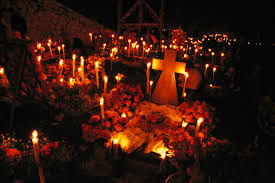
The day after Halloween - All Saints Day - my family always headed to mass to  celebrate the 10,000 or so saints and martyrs of the Catholic Church, with everyone else who has died honored the next day, All Souls Day.   In Protestant churches, where we consider all who have accepted Christ to be saints, we honor all those who have gone before us.  Latinx families celebrate today as Dia de los Muertos, Day of the Dead, with meals at their loved ones’ gravesides, sugar skulls, and parties.  It is a wonderful celebration.  Disney fans who didn’t know what it was learned when they watched the animated film Coco.  But however we celebrate, this is a special day in the life of the church.    It is appropriate that this passage from the Book of the Revelation to John be our focus today.


As John looks on, he sees a great multitude - so many people no one could count them all - from every nation and tribe, speaking every language - standing at the foot of the Throne, worshipping God and the Lamb of God.  An elder asked him who these people were, but John turns the question back on the questioner, who tells him that these are the ones who have come out of the great ordeal, those who have washed their robes and had them made white in the blood of the Lamb.


It is hard to know with this book just when John was visiting heaven in his vision.  If it was at the time he was living there not anywhere near that many believers in the whole world yet, never mind believers who have already died.  People who lean toward the idea of universal salvation point to this reading as a confirmation of their belief.  


On the other hand, given that we believe God is eternal, and heaven is eternal, it is quite possible his vision was of the far future, when this huge number of believers who have gone before seems much more reasonable to us.  After all, it seems to us that being washed in the blood of the Lamb means believers, Christians.  And given that his vision is of the End of Days and that hasn’t happened yet, it is reasonable to think this is a vision of the far future.  Far from John’s time, at least.


Mind you, that has not kept a huge number of false prophets from arising on a pretty regular basis and convincing people that the end is near, next week, or month from now, or on January 1, 2000.  Multitudes have believed them, and given away all their possessions, gone to the mountaintop with their prophet and waited to be raptured - or committed mass suicide. At best they are embarrassed, many are impoverished. People keep thinking they can see the signs . . .And I keep coming back to Matthew 24, when Jesus says very clearly that no one knows the day or the hour, not the angels nor the Son, but only the Father.  


But these, this multitude at the foot of the throne, these are those who have already gone through the great ordeal.  These have lived their lives and died.  They have suffered pain and loss. They have celebrated and loved.  How they died, or when they died, is less important than that they lived, ordinary human lives.  And life, all by itself, is an ordeal.  In the musical, Alexander Hamilton is eager to go into battle, to fight and die a martyr to the revolution.  General Washington tells him, “Dying is easy, young man. Living is harder.”


As Christians we are told, and we believe, that we do not have to grieve as others do, who have no hope. Even so, living with the grief of losing a loved one is hard.  And grief does not end. It may become easier to live with, but it is always a part of us.  It is part of the great ordeal that is life.  Oh, we get some encouragement when we hear,


They will hunger no more, and thirst no more;

    the sun will not strike them,

    nor any scorching heat;

for the Lamb at the center of the throne will be their shepherd,

    and he will guide them to springs of the water of life,

and God will wipe away every tear from their eyes.”


Hearing these words helps us to know that our loved ones, our dearly departed, are well, and waiting for us.  Also helpful are our rituals around death and dying.  We gather at the bedside when the end is near.  Family comes from near and far.  We all come together for viewings and wakes and funerals and meals after funerals.  Sharing the stories of their lives, sharing our grief and our laughter, getting to see cousins or even siblings we haven’t seen in years, and their children and grandchildren.  All this is part of that ritual.  It is part of how we grieve.


But there’s this pandemic. Everything has changed.  We can’t visit our loved ones in the hospital.  We can’t have funerals the way we are accustomed to.  Even graveside services are limited to 10 people.  Large family gatherings are discouraged.  Flying is riskier than usual, so traveling to see our families in our time of grief is so much more difficult.  And so we must grieve alone. Oh there’s FaceTime and Zoom and Google Meet . . . but there are no hugs.  No gentle touch on our shoulder.   


And there are so many more deaths this year.  As of Friday there have been 228,100 in the US so far this year from Covid19.   1,200,000 Covid deaths worldwide. That’s a lot of families grieving.  My friends and colleagues in places where Covid is  surging are overwhelmed by the sheer magnitude of deaths, and their feelings of helplessness.


And so we come to All Saints Day, bearing our grief and our confusion. Typically, any other year, the Table would hold small candles, lots of candles.  We would come forward and light one or more for the people we are grieving.  We might speak their names, or light the candles in silence.  We would come together to recognize and share our losses.


We cannot do that today.  What we can do, and will do, is have the Quarantine Qrew light candles for us.  As they do so, I would invite you to name your loved ones just as you would if we were together in person. If you can, you may light your own candles at home for your dearly departed.   And be comforted, for they are before the throne of God, worshipping day and night, sheltered from all harm.  And know that they will hunger and thirst no more, and God will wipe every  tear from their eyes.


Amen.


Sunday, October 25, 2020

Giving is Loving


Matthew 22:34-46. NRSV

34 When the Pharisees heard that he had silenced the Sadducees, they gathered together, 35 and one of them, a lawyer, asked him a question to test him. 36 “Teacher, which commandment in the law is the greatest?” 37 He said to him, “‘You shall love the Lord your God with all your heart, and with all your soul, and with all your mind.’ 38 This is the greatest and first commandment. 39 And a second is like it: ‘You shall love your neighbor as yourself.’ 40 On these two commandments hang all the law and the prophets.”


41 Now while the Pharisees were gathered together, Jesus asked them this question: 42 “What do you think of the Messiah? Whose son is he?” They said to him, “The son of David.” 43 He said to them, “How is it then that David by the Spirit calls him Lord, saying,

44 ‘The Lord said to my Lord,

“Sit at my right hand,

    until I put your enemies under your feet”’?

45 If David thus calls him Lord, how can he be his son?” 


46 No one was able to give him an answer, nor from that day did anyone dare to ask him any more questions.


**************************************************************


Good morning!  I am back, all rested and relaxed from 10 days with no Facebook or other electronic disturbances.  I hope you all enjoyed the guest preachers the last two weeks. I certainly did.


Today is the last Sunday of our annual Stewardship Campaign, which we call Consecration Sunday because it is the day we bless the pledges we have received so far.  The Quarantine Qrew will be doing a special blessing later in the service. Most of the pledges received will be monetary.  Some will be a commitment to give time or talents to the service of God.   You might have noticed that I said we are blessing the pledges we have received so far.   That’s because, unlike your ballots in the elections, there is no due date for your pledge.  It is not too late to send it.  It will be accepted and added to the total whenever it gets here.


(And speaking of ballots - please vote.  It’s important.  Every vote counts. Vote for whomever you choose, just please vote.  This has been today’s public service announcement.)


The two greatest commandments.  Most of you are very well aware that on any given Sunday I will most likely mention these at least once, and probably also the commands in Matthew 25 to feed the hungry, clothe the naked, and so on.  It is said that every preacher really only has one sermon - and this is mine.


The Pharisees and the Sadducees. Two different schools of theological thought.   Sadducees did not believe in resurrection at the end of time, or an afterlife, or any kind of spiritual realm - angels and demons and so on.  They followed a very literal interpretation of scripture - if a law could not be found in the Tanakh (the Hebrew Scriptures) it had to be manmade and therefore non-binding.  The Pharisees accepted both scripture and oral tradition as authoritative, believed that all persons would be resurrected in their bodies on last day, that there was life after death, as well as angels and demons and so on.  They were both politically powerful, both were represented in the Sanhedrin, the supreme court of Judaism.  Their rivalry was so fierce that, if they were college football teams, they would be Army and Navy. 


So when the Pharisees heard that Jesus had shut down the Sadducees, well, you know, they had to test Jesus themselves, with the thought that they could catch him out with some legal question, cause, you know, they could certainly come up with better questions than the Sadducees.  They had no objection to his reply about the greatest commandment, but then he asked them a question.  Who is the Messiah - whose son is he? When they said David, he pointed out that David referred to the Messiah as Lord, and how could a king call the son of a king “Lord”?  This had not occurred to them before, obviously, because it totally stumped them.   Matthew tells us that “No one was able to give him an answer, nor from that day did anyone dare to ask him any more questions.”.  This certainly had to add to their dislike of and disdain for Jesus.  There is, after all, little that academics hate more than being shown up by someone without their credentials, their level of formal education - and Jesus was definitely not educated in the same way they were.


Jesus was nearly always respectful of others.  He didn’t laugh or make fun of the Pharisees or Sadducees when he pointed out fallacies and contradictions in their arguments.  He rarely called anyone names - unless he was really angry, temple courtyard table tossing angry.  In this way he showed them the kind of love that he kept talking about, which was to treat others as you would want to be treated.  To care for others as you would want to be cared for.  Helping the man on the side of the road.  Giving your last mite to the Temple, not out of obligation, but out of love.


Giving is loving.  You know that we sometimes have special offerings, to support our Regional Church, colleges and universities, the Pro-Reconciliation Anti-racism effort, or to help victims of natural disasters.  Those special, extra offerings help our larger church walk into God’s vision for the world, where there is no more oppression, and no one has to suffer alone, and hatred has been replaced with love.  The gifts we give to those special offerings are over and above our regular offerings so that God’s vision may be carried out on a much larger scale than just what we can do here, in Selma.  Our regular offerings help us to do our best work here, in this city, to combat hunger and to carry God’s word to the people who need to hear it outside our congregation.  Whatever we can give in love helps us to walk into it, and fulfill God’s vision.


Gwen was a a tiny, white haired bundle of energy.  A pillar of church. From the time she was in college right up until the day of her death, she devoted nearly all of her time to doing social justice work.  She was actively involved in the Civil Rights movement, and the Farmworkers movement, and the fights for Women’s rights and Gay Rights.  By profession a teacher, by inclination a lifelong learner, she attended classes, workshops, and lectures on pretty much everything.  If there was anything at all happening at the church, Gwen was there to help out.  One day she told me that she and her late husband had stopped tithing decades earlier.  After I stopped mentally freaking out - because I couldn’t imagine them giving less than the full 10% - she said that they gave so much of their income to the church and other charitable organizations that, as school  teachers with 4 children, the IRS had trouble believing it.  When she said they were not tithing, what she meant was they were no longer limiting themselves to 10%.  Giving is loving, and Gwen may have been the giving-est and the loving-est person I ever met.


June once told me that she gave 20% of her retirement income to the church, but admitted she had very few expenses - she lived with her sister and brother-in-law who supplied pretty much everything she required.  She wasn’t well enough to do much else to help out, so she gave as much money as she could so the congregation could continue doing God’s work in our community and beyond.  Giving is loving.


As for me. . . At that time I was lucky to be able to give 2%, maybe as much as 5%. It was expensive to live in Southern California, and I was over whelmed with debt - student loans, medical bills and credit cards.  Today my situation is much better but then I simply could not give more. I know many people share that reality, especially right now in the middle of a recession.  Giving is loving.  We can only give what we have to give.


Eusebio had very little.  His income as a dishwasher did not stretch far enough for first and last month’s rent, so he slept in the doorway of the church until he had saved up enough for a deposit on a room.  He spent many hours every week cleaning up and fixing up anything around the outside of the church that needed attention.  He even re-painted the stripes in the parking lot with paint he found in a dumpster.  No one asked him to do these things. This was his gift, his pledge, given in love and gratitude, so that the congregation could focus on other things.  Giving is loving.


Because we love God, we want to do those things that are required of us.  We want to love our neighbors as best we can. In love and gratitude we want to give our best - our finances, our gifts and talents, our time, our willingness just to show up.  The gifts we give, no matter what those gift might be, will help us to walk into God’s vision for the world, a world where justice is tempered with mercy, God’s peace fills every heart, and God’s love is shown to all persons.  Let us then, give as generously as we possibly can, let us give our very lives to God - for giving is loving, and we are commanded to love.

Sunday, October 4, 2020

God’s Plan


 Scripture.  Isaiah 5:1-7 New Revised Standard Version     


5 Let me sing for my beloved

    my love-song concerning his vineyard:
My beloved had a vineyard
    on a very fertile hill.

2 

He dug it and cleared it of stones,
    and planted it with choice vines;
he built a watchtower in the midst of it,
    and hewed out a wine vat in it;
he expected it to yield grapes,
    but it yielded wild grapes.

3 

And now, inhabitants of Jerusalem
    and people of Judah,
judge between me
    and my vineyard.

4 

What more was there to do for my vineyard
    that I have not done in it?
When I expected it to yield grapes,
    why did it yield wild grapes?

5 

And now I will tell you
    what I will do to my vineyard.
I will remove its hedge,
    and it shall be devoured;
I will break down its wall,
    and it shall be trampled down.

6 

I will make it a waste;
    it shall not be pruned or hoed,
    and it shall be overgrown with briers and thorns;
I will also command the clouds
    that they rain no rain upon it.

7 

For the vineyard of the Lord of hosts
    is the house of Israel,
and the people of Judah
    are his pleasant planting;
he expected justice,
    but saw bloodshed;
righteousness,
    but heard a cry!


********************************************************************

Message God’s plan? 


It is one of those Sundays again.  You know, the kind of Sunday that has a bunch of different things going on that we are supposed to be paying attention to.  It is Reconciliation Sunday, when we pay particular attention to the Anti-Racism, Pro-Reconciliation emphasis of our denomination - and take a special offering for that program.  It is World Communion Sunday - the one Sunday a year when Christians around the world celebrate the Lord’s Supper together, even those who only celebrate once in a very great while.  In case you hadn’t heard, we have a special service planned for 12:30 this afternoon on the front lawn of the church where we will all share in the Lord’s Supper - with individual communion sets, wearing masks and appropriate distancing between your lawn chairs.  But we will all be in one place together for the first time in over 6 months!    


And it is the first Sunday in Stewardship Month.  It is also the Sunday before I take a week off because we are having awesome preachers the next two weeks!  Our Regional Minister Toni Bynum will preach next Sunday and Terrell McTyer, Minister of New Church Strategies for our General Church the following week.  You can bet that I will be glued to our YouTube channel during worship those days!  I am really looking forward to hearing both of those sermons!  


In the reading we heard this morning, Isaiah speaks to the people and tells them a story about a man with a vineyard, who did everything exactly right to make the vines grow and be exceptional.  But they didn’t.  They were like wild grapes. So he abandoned the vineyard.  He asks the people of Judah to judge whether he had done the right thing.


Clearly, Isaiah is not talking about an actual man with a vineyard.  Rather he is telling a story much like the one that Nathan told David, after he committed adultery with Bathsheba - the story about the rich man with many sheep, and the poor man with only one.  But the rich man stole the poor man’s one sheep - so what should be done?  David said the rich man must be punished severely; Nathan pointed out that he was the rich man with many wives, while Bathsheba had been Uriah’s only wife.


Isaiah says to the people of Judah, God gave you everything, everything you could possibly need to be an excellent nation.  A righteous nation, where all the people were cared for, where no one was oppressed, where God’s will was the will of the leaders - not greed or lust for power, but the desire to serve God’s people as they were commanded to do. And you aren’t doing that.  My people are crying out.  They are hungry, and sick and mistreated. Should God abandon you, as that man abandoned his vineyard?  God had a plan, and it didn’t happen the way it was supposed to - you all did not follow the plan.


We, humans, can mess up God’s plans in a heartbeat.  We might like to think that God’s plans are carved in stone, but there’s that pesky free will thing.   All we have to do to derail God’s plan is think about ourselves first, and not God.  All we have to do is put the love of money first, not the love of God.  Meanwhile, God waits for us to do what is expected of us . . which I imagine is as frustrating to God as watching an update load when we have something important to do on our computers.


———-


We will spend this whole month talking about Stewardship, which can easily translate into Preaching about Money.  It is, and not. 


When we were talking over the theme for our Stewardship Campaign, it was pretty clear to us that we need to look at giving in a different way.  Not giving to the budget, but giving to God’s mission and vision.   I know some of you will say God doesn’t need money and you are absolutely right.  God does not need money.  But if we are expected to feed the hungry and heal the sick and bring hope to the hopeless, and end every kind of oppression - if we are expected to do these things to carry the Good News as God has commanded us to do, planned for us to do - We need money to provide education and materials and work space and storage space for the people doing that work.


See here, God  does not complain that there isn’t enough lamp oil in the Temple, or that the quality of the incense has gone down.  God complains because God’s plan is not being brought to fruition. God complains because the people of Israel have been given every advantage and pretty clear directions on how to live, how to take care of each other.  The harvest expected from the Chosen People was justice, but God saw bloodshed.  God expected righteousness but heard the people crying out under the weight of oppression. 


God did not just tell the people of Israel to tithe, but also how the gifts they gave to the Temple were to be used, and a good portion of it was intended to care for the poor, the widows and orphans, and the strangers among them, the sick and hungry.  God told the people how to take care of each other, knowing that if they followed directions the harvest of righteousness and justice would be bountiful.  It wasn’t just the leaders who were told how to do these things - it was all of the people.  All of the people are responsible for acting justly, with mercy, compassion and generosity.


Here’s the other piece about Stewardship.  Stewardship is also about people doing the work.  A vineyard cannot thrive no matter how much is spent on setting it up. It requires workers to care for the vines, to make sure they are watered, and no pests are threatening the grapes.


A congregation can be rolling in funds - they can have enough money to buy up all the land around them and build education wings and start a coffee shop inside the narthex and buy the pastor a private jet - but if the people do not go out to serve those who need their help, that congregation is not fulfilling God’s plan.  So Stewardship is two things - giving from your wallet, and giving of your gifts and talents - of the things that bring you joy.  When Liz and her helpers prepare a meal for the Christian Cafe, or when Karleen picks up the food to distribute at the SMART Center, or when Jordan spends half his week making sure this worship service is planned and music selected and recorded and all the different parts spliced together and finally uploaded so you all get to participate - they are doing things that bring them joy.  When Jennifer goes out with the Selma Beautification team to pick up trash and make our city a better place to live, when Alan goes out with the teams that count the homeless, when Omar and Jessica staff our table at a Bringing Neighbors Together Block party - they are doing things that help the people in our community.  Laurie plans and teaches our Children’s Church, Aubrey educates all of us about chronic illness and mental health issues . . .they are sharing what they are passionate about as a service to God’s people. When any of us speaks out against any kind of oppression - racism, homophobia, sexism, economic oppression - we are working toward a world where God’s justice is done.  We are working toward fulfilling God’s plan.  IF you have a thing you love to do, or a thing you would love to try to do, write that on your pledge card and we will find a way for you to do that thing to serve God’s people.


God provides everything we need to produce a fruitful harvest of generosity and justice and righteousness.  We are showered with gifts in abundance.  It is true that right now, in the middle of a pandemic and an economic recession, many who were doing ok before suddenly have no job, and no way to earn a living.  People who were doing ok before are suddenly finding themselves depending on food distributions to feed themselves and their families.  This is the reality we are living in.  And this reality means that some who could give before cannot right now.   Not money, anyway.  God’s gifts are not all financial.  For those who cannot give from their wallets, this is the opportunity to give from your hearts.  To reach out to someone who is alone, and let them know that they are not alone.  Share your passion for justice, or teaching, or music, to help heal the hearts and spirits of the depressed and tired.  Share the gifts, which God gives in abundance, so that all the world might come to know God’s love and compassion.


God’s plan for the world is for it to be a place where following God’s will is the rule, not the exception.  In order to bring that plan to fruition, God has showered each of us with gifts that know no ending.  Let us use those gifts and follow God’s plan for us, providing that bountiful harvest of righteousness and justice that God desires.


Saturday, September 26, 2020

Saying yes and saying no

Scripture Matthew 21:23-32


21:23 When he entered the temple, the chief priests and the elders of the people came to him as he was teaching, and said, "By what authority are you doing these things, and who gave you this authority?” 24 Jesus said to them, "I will also ask you one question; if you tell me the answer, then I will also tell you by what authority I do these things. 25 Did the baptism of John come from heaven, or was it of human origin?" And they argued with one another, "If we say, 'From heaven,' he will say to us, 'Why then did you not believe him?’ 26 But if we say, 'Of human origin,' we are afraid of the crowd; for all regard John as a prophet.”  27 So they answered Jesus, "We do not know." And he said to them, "Neither will I tell you by what authority I am doing these things.


28 "What do you think? A man had two sons; he went to the first and said, 'Son, go and work in the vineyard today.’ 29 He answered, 'I will not'; but later he changed his mind and went. 30 The father went to the second and said the same; and he answered, 'I go, sir'; but he did not go. 31 Which of the two did the will of his father?" They said, "The first." Jesus said to them, "Truly I tell you, the tax collectors and the prostitutes are going into the kingdom of God ahead of you.


32 For John came to you in the way of righteousness and you did not believe him, but the tax collectors and the prostitutes believed him; and even after you saw it, you did not change your minds and believe him.


********************************************************************************************


Message Saying Yes and Saying No


Good morning, or afternoon, or maybe evening - depending on when you are joining us for worship.  Whenever it is where ever you are right now, it is a perfect time to worship.  


When I select the Scripture reading for each Sunday I determine a focus for the message.  Maybe a particular verse captures my attention, or maybe a proverb or truism pops into my mind when I read it.  The reading and the focus help me select a hymn that reiterates my point - and helps Jordan select all the other music for that Sunday.  This way when the time comes to preach on any particular passage I have a good idea of where I want to go.   More often than not I will have come back to it a few times and jotted down a story or a point I want to be sure to make.  I did all that with this one but somehow my usual plan went sideways.  Apparently I was jotting down ideas based on the title instead of the focus.  And I have no idea what I was thinking when I chose the hymn.  Luckily Jordan chose lots of good ones, and the Quarantine Qrew’s singing always makes everything ok. 


The title is Saying Yes and Saying No.  And with a Presidential Debate coming up this week it was hard to get the idea of debating out of my mind.  I mean, yes, Jesus was engaged in a running debate with the Pharisees and the Sadducees.  At every encounter he confounded them with his knowledge and his eloquence.  But the thing about debates is that they rarely change the mind of any one whose mind is already made up.  They might sway a person who’s kind of undecided, but the true believers already know what they know, and no amount of logic or eloquence is going to change that.   


A story my mother used to love embarrassing me with is about the day she walked into the room where my sister and I were supposed to be napping only to find us standing up in our cribs, one yelling yes and the other yelling no. No idea what that was about. But I suspect I was the No, because I tend to say no quickly.  Sort of like the character Jim on the Vicar of Dibley, who begins every sentence with “No no no no no no.” 


Jesus was teaching in the Temple, so the chief priests and elders wanted his credentials.  He wasn’t from one of the priestly families.  He hadn’t spent his life at the feet of a teacher in the Temple learning the Law and the Prophets.  So they asked, where do you get your authority to teach the way you do? Because, it really is different to what we are used to teaching.  And we don’t know you.  Jesus took the opportunity to ask another “Who do you say that I am?” question - where do you all think John got his authority to baptize?  Because everyone knew by this time that John had been talking about Jesus, so where ever John got the authority had to be where Jesus got his.  They had to say “I dunno” because no matter what they said, they were going to get themselves into trouble.   If they thought John, and by extension Jesus, was authorized by heaven, then they were clearly on the wrong side of the conversation.  But the people thought John and Jesus, came from God, so if the priests and elders said they didn’t, the people would turn on them.


Jesus knew why they answered that way, of course and declined to let them off the hook - or to answer their original question. Instead,  he tells a story of two sons whose father wants them to go work in the vineyar.  One tells his father he will not go work in the vineyard but does.  The other says he will but doesn’t.  The priests and elders agreed that it was the first who did God’s will.  Actions speak louder than words.  


Sometimes God calls us to something that we really don’t want to do.  Maybe we are comfortable just the way we are.  Or we have a zillion reasons why we can’t do it - maybe finances or lack of self confidence.  My experience has been that if God wants me to do something and I choose not to - there will be pain.  I have learned that it is better to just do whatever it is, because none of my excuses will matter. If God called me to it, God will lead me through it.  God will make a way somehow.  Even if, like the first son, you don’t want to do the thing, and say you’re not going to do the thing,  for whatever reason, but you go ahead and do it anyway even though you really do not want to, you are still doing God’s will because actions speak louder than words.


If, on the other hand, you say Yes Lord! but don’t make any effort beyond that . . .

Well, Jesus said to his disciples “Not everyone who says to me, “Lord, Lord,” will enter the kingdom of heaven, but only the one who does the will of my Father in heaven.” (Matthew 7:21).   Even if that one says “No” before saying “yes”.


The chief priests and the elders held positions of importance among the Jewish people.  They were community leaders.  They had important jobs.  They upheld tradition. They had said yes to God, but they only did the things they had always done the way they had always done them. They believed they were doing right by God and the people.  They were used to things being a certain way, and being taught a certain way.   And Jesus was turning their world upside down.  They were teaching the way things had been taught for ever and Jesus shows up with the Common Core.  They were not ready for this, and they were not sure what to do about it.  They found themselves on the defensive.  And so, when asked where John’s authority derived, they had to say, “I don’t know.” 


And Jesus said to them, you may not want to believe, or to admit that you believe, but the tax collectors and the prostitutes believe.  Even the people you won’t allow in the Temple to worship, people who aren’t good enough for you to sit down and eat with, those people whom you despise are being saved before you, because they are saying yes where you are saying no.  They aren’t letting preconceptions or antiquated traditions get in the way of hearing God’s call to change their hearts and lives.  They are not as afraid of change because the traditional ways of doing things aren’t doing them any good.  Doing things the way we have always done them only helps the folks already in positions of power.   And they will do anything to keep from losing that power.


The chief priests and the elders didn’t know Jesus because he was not one of them, he was not one of the people in power. Jesus came as an ordinary man, not a royal prince, not a member of the priestly families.  He walked among the poor, worked among them, he WAS one of them, he knew their lives as well as they did, because this was his lived experience.  He knew society from the bottom.  He knew what it was to be the object of prejudice, to hear people say, “Can anything good come out of Galilee?” Jesus preached from a position of solidarity with the people who most needed him, against oppression, against focusing on the letter of the law rather than the spirit of the Law, against people in positions of power who chose not to help the people who needed their help the most.  Jesus spoke for the poor, the hungry, the helpless and the hopeless, the lost and the last.  He spoke for justice with mercy, for compassion, for love.  He told the story of a man who did not want to serve God when called, but went to work in the vineyard anyway.  And the one who talked a good game, but chose to do nothing.  


We are given the choice every day between saying yes, and saying no.  When you hear God’s call, which will you say?

Saturday, September 19, 2020

Reaching Consensus


Scripture.   Matthew 18:15-20. NRSV

18:15 If another member of the church sins against you, go and point out the fault when the two of you are alone. If the member listens to you, you have regained that one.16 But if you are not listened to, take one or two others along with you, so that every word may be confirmed by the evidence of two or three witnesses. 17 If the member refuses to listen to them, tell it to the church; and if the offender refuses to listen even to the church, let such a one be to you as a Gentile and a tax collector.


18 Truly I tell you, whatever you bind on earth will be bound in heaven, and whatever you loose on earth will be loosed in heaven.


19 Again, truly I tell you, if two of you agree on earth about anything you ask, it will be done for you by my Father in heaven. 20 For where two or three are gathered in my name, I am there among them."


**************************************************************** 
Good morning!  

As usual, I selected the scripture reading for today months ago. You may remember that I swapped the Laborers in the Vineyard parable with another so I could use that one on Labor Day Sunday.   This is the other.   


A lot of what Jesus taught to his followers was simply how to get along with other humans.  We’re rather good at not getting along, and indeed, he seems to take it as a given that members of the congregation will come into conflict with one another.  I do want you to know that I disagree with the way a couple of words were translated. First, the word translated from the Greek as church in verse 15 is actually adelphos, (ᾰ̓δελφός) which means brother, so that’s just inaccurate.  That verse might more accurately be read as “If a brother sins against you...”  Then, an entirely different Greek word is translated as church in verse 17 - Ecclesia (ἐκκλησία).  It means assembly, or even congregation, and although over time it did come to mean church, so that by the time the Bible was translated into English this would have been an accepted meaning, in Jesus’ lifetime there was as yet no church.  This is a specifically Christian word.  And there were no Christians yet.  And while I realize that this may just sound like semantics, we need to remember that Jesus was a Jewish teacher and healer.  He might speak of the Temple or synagogues, but not church.  When he used the word ecclesia he would have meant the assembly of Israel, all Israelites. 


And I know you probably don’t care about the Greek, well some of you might, but it is important to know what the original meaning or intent of a passage was, and to do that we sometimes have to look back to the original language.  I try not to do this too often because when I was at Chapman the pastor of the Disciples Church I attended spent quite some time every Sunday waxing eloquent on the original Greek or Hebrew of that day’s reading - and it really annoyed me.  Today it fascinates me, but I hadn’t studied Greek yet at that time.


Today our nation grieves the loss of Justice Ruth Bader Ginsberg, who sat on the Supreme Court for 27 years.  She was the second woman ever to serve as a Supreme Court Justice and was a fierce advocate for gender equality. Hundreds of people gathered Friday evening at the Supreme Court building, leaving flowers, weeping and even singing - America the Beautiful, the Beatles’ Imagine, and Amazing Grace.  She will be missed.   The Supreme Court has seven members so that if there is ever a tie in a decision, the Chief Justice can cast the deciding vote.  That happens more often than we might hope.  But that’s the way our system works -  one more than 50% is a majority, and majority rules.


Another method of decision making is consensus.  According to Merriam-Webster consensus is a general agreement, or the judgment arrived at by most of those concerned, or group solidarity in sentiment and belief.  Consensus means generally accepted opinion. One example is most people believe that it is wrong to kill another person (YourDictionary.com) 


Consensus means every one is on the same page. Sounds easy enough. Unless, of course, you and a group of friends are trying to decide where to go for dinner, or what movie to watch.   (Vocabulary.com).   Jesus was aware of this, as well, which may be why he said, “if two of you agree on earth about anything you ask, it will be done for you by my Father in heaven.” thus encouraging us to come to a place of sufficient agreement that we are in one accord about how to go forward. 


I remember the years of peace talks around ending the War in Vietnam.  Ten Weeks! were taken up with arguing over what shape the table they used for meetings should be.  They had to reach consensus, because if everyone could not come to an agreement the Peace Talks would not go forward.  It took another five years before all the parties involved could reach an agreement.  And although not everyone was 100% satisfied, they were sufficiently in agreement that the Accord could finally be signed.  That’s what consensus takes - unless you are Quaker.


Quakers, known as The Society of Friends, do consensus. 

Quaker decision-making is grounded in the belief that when several people come together to labor in the Spirit they can discern a truth that exceeds the reach of any one individual. In making decisions Friends do not simply vote to determine the majority view, rather they seek unity about the wisest course of action. The goal is "unity, not unanimity." (The Disciples goal is unity, not uniformity, which is very similar.). Over time Friends have developed ways to conduct meetings that nurture and support this discernment process. Ensuring that group members speak only once until everyone who wishes to speak has been heard encourages diversity of thought.  Respecting the opinions of others is critical.  Listening is crucial.  Looking at each other - Quaker meeting houses often have rows of seats facing each other.  When you look someone in the face while they are speaking, you can hear what their heart is saying better. It is not an easy process.  I have read accounts of meetings that go on for a very long time until that one last hold out agrees that, while not 100% satisfied, he can live with the decision.  Unity, not unanimity.  


Don Shelton was the Regional Minister of the Christian Church (Disciples of Christ) in the Pacific Southwest for 12 years.  I heard him say more than once that if a congregation’s decision about pretty much anything was 50% plus 1 vote, it would probably be wise to take that particular issue back for re-consideration until consensus could be reached.   Don’t give up on whatever it was, but work hard to come to an agreement.  Whether it is the color of the new carpet, the calling of a new pastor, or the decision to become Open and Affirming, if more than 10% of the members are in opposition, there’s a fairly good chance it will not go well.  


Now, I have heard a lot of horror stories about Church Boards - no matter what title that group has. I bet you have too.  I’ve heard of Boards keeping secrets about their financial condition, one family running the congregation for decades, feuds between different factions of the Board . . .  Church politics can get pretty ugly.  I have attended a lot of Church Board meetings, and maybe I’ve just been blessed, but what I see more often than not is a serious attempt to reach consensus on every issue.  Most Boards, and especially this one here at First Christian Church in Selma, are willing to continue discussing any item until reaching a place where everyone can live with the decision they make.  Yes, Board meetings often take a long time, but the reason for that is that the people who serve really care about what is best for the congregation, so they want to make sure that any decisions they make on behalf of the congregation will serve God and the church the best way they can determine. We can do that same thing outside of Board meetings. (By the way, Board members - we do have a meeting today at 2 pm on Zoom.  See you there. Except maybe Dave, who is visiting his son).


Our world is far from peaceful right now, but we can make it so.  If we, as church and as individual children of God, seek to really listen to each other, to respect the other’s opinions, to look at each other so we can hear what their heart says, then no matter what the topic, we can start the work of reaching consensus . . . agreement . . . peace.  God’s gift of peace is precious, and we can have it if we truly want it. It will take very hard work, but it can be done, if we don’t give up, if we keep seeking ways to agree instead of ways to disagree.  All we have to do is reach consensus, for Jesus promised where two (or lots) agree on what you are asking, it will be done for you. 


Go out therefore,

to seek agreement, 

to seek consensus, 

to seek God’s will, 

to seek peace.

Sunday, September 13, 2020

Love your Vegan Neighbor

 Scripture: Romans 14:1-12. 

14 Welcome those who are weak in faith, but not for the purpose of quarreling over opinions. 2 Some believe in eating anything, while the weak eat only vegetables. 3 Those who eat must not despise those who abstain, and those who abstain must not pass judgment on those who eat; for God has welcomed them. 4 Who are you to pass judgment on servants of another? It is before their own lord that they stand or fall. And they will be upheld, for the Lord is able to make them stand.


5 Some judge one day to be better than another, while others judge all days to be alike. Let all be fully convinced in their own minds. 6 Those who observe the day, observe it in honor of the Lord. Also those who eat, eat in honor of the Lord, since they give thanks to God; while those who abstain, abstain in honor of the Lord and give thanks to God.

7 We do not live to ourselves, and we do not die to ourselves. 8 If we live, we live to the Lord, and if we die, we die to the Lord; so then, whether we live or whether we die, we are the Lord’s. 9 For to this end Christ died and lived again, so that he might be Lord of both the dead and the living.


10 Why do you pass judgment on your brother or sister? Or you, why do you despise your brother or sister? For we will all stand before the judgment seat of God. 11 For it is written,


“As I live, says the Lord, every knee shall bow to me,
    and every tongue shall give praise to God.”

12 So then, each of us will be accountable to God.


*******************************************************************


Good morning.   As of Saturday afternoon, when I recorded this, 196,000 acres had burned in the Creek Fire which was 6% contained.   The air quality was terrible - probably still is on Sunday morning.  I hope you are all able to stay inside, away from the smoke. And that you are safe from the fires, and the virus, and all other dangers.  


Some years back I started having trouble with meat - all meat. It wasn’t a moral thing.  Meat just was not agreeing with me for some reason. So I was living as a vegetarian craving meat. After a year or so I started trying meat a little at a time and discovered which ones I could eat with no trouble, and which ones were still a problem.  *sigh*. Anyway, While living meat free I discovered a Vegan restaurant not far from my church. I tried everything on their menu and most of it was pretty good.  Not the hot dogs, though.  I discovered, much to my surprise, that Vegan ice cream is not only tasty but because it is not dairy, there was no grease stain left when I inevitably spilled some on the front of my shirt.  Which has nothing to do with anything, really, but. . . .  


When I was going to that restaurant regularly some of the servers were pretty hard core evangelistic Vegans.  You know the kind - the ones who want to convert the entire world to a totally plant based diet, who will go on at some length about the immorality of killing animals for food. Some even made a point of quoting Genesis, where Adam and Eve were told they could eat all the grains and fruits of the earth - but not meat.  Because I was sitting there waiting for my meal I was kind of a captive audience - it wasn’t usually really busy at the hour I went for lunch.  I must admit that I started only going there on the days those servers did not work, because you know, they were pretty annoying.  I like Vegan food ok, but I’m really happy that I can eat meat again.


Although, did you know that Oreos are actually made from vegan ingredients including pure cocoa (not chocolate) and “cream” made from soy, oil and corn.  So next time you eat a sleeve of Oreos in one sitting don’t feel guilty. Be proud of yourself for leaving your comfort zone and exploring Veganism. 


The congregations in Rome had a number of disagreements. One of them was about eating meat and drinking wine.  The Jewish Christians who followed Jewish dietary laws did not eat meat or drink wine that might have been sacrificed to one of the many gods worshipped in the Roman Empire before being offered for sale in the marketplace.  The Gentile Christians had no such concerns, and considered the Jewish Christians weak because of their lack of freedom in this regard, whereas the Jewish Christians condemned the Gentile Christians, the ones Paul refers to as strong, for what they considered to be an illicit use of freedom.  Just because you can do something, doesn’t mean you should.  Likewise, Jewish Christians continued to observe certain holy days specific to Judaism which Gentiles did not observe, such as the Day of Atonement, and certain fast days.  Even which day was designated as the correct day to worship came under fire, as Jews wanted to continue to observe the Sabbath (Saturday) and worship on that day, whereas Gentiles tended toward worshipping on the Day of the Lord’s Resurrection (Sunday).  


Paul’s response to all of this was very much like the Disciples of Christ’s viewpoint - in those matters which are not essential for salvation, as long as one honors and thanks God in their observance, those practices that are different are unimportant.  Each must accept the other as honoring God in their own way, without requiring that all practice their faith in exactly the same manner.  “You must not pass judgment,”  Paul said, “for God has welcomed them.”  I can’t help but think of the story I told some time back, about the woman who proudly proclaimed that because she only wore long skirts she was a real Christian unlike those women who wore short skirts or pants.  How essential to salvation is what one wears, really?  Or whether one worships on Saturday or Sunday?  Or whether one drinks juice or wine at the Lord’s Table?  Or whether one eats meat or tofu?  “Why do you despise your sister or brother? For we all stand before the judgment seat of God.”   Truly I say to you, how you treat one another is far more important when it comes to matters of salvation than how you dress, or what you eat, or who preaches. . . . Or how you vote.   


If you pay any attention to the news, whether on the internet or on television or in print, you will most likely be aware that some Christians claim that you cannot be both Democrat and Christian, while other Christians claim that you cannot be both Republican and Christian.  I am quite certain that neither of those positions can find justification in Scripture.   Actually I am very well aware that both of those positions find much in Scripture to justify their points of view, but I would say both are wrong.  And I say that because these are judging each other in exactly the way that Paul says not to do. They are despising each other, quarreling over opinions.  Each chooses their position, selects portions of the Gospels or the Epistles or even the Old Testament that seems best to fit their point of view, and uses those verses as a weapon against the other side.  Just as the Jewish and Gentile Christians did back in the day.  “Look,” says one. “Jesus showed very clearly that those old laws don’t suit in these situations.  He healed on the Sabbath, and ate with lepers.  So we don’t have to worry about Sabbath observance or purity laws any more.” “Wrong,” says the other. “Jesus says he came to fulfill the law, and that until heaven and earth pass away, not one letter, not one stroke of a letter, will pass from the law until all is fulfilled.”    And Paul said, “Who are you to pass judgement?  It is before their own Lord they will stand or fall.”  As long as you vote your conscience, as long as you vote in the way that you believe best serves God and God’s people, as long as you believe your vote honors God, and you give thanks to God that you live in a time and place where you can vote, as long as you are fully convinced in your own mind, you will be upheld by the Lord your God.   Just please, vote.  Get registered if you aren’t already, and get informed, and vote.  


Whatever we do, if we are Christians, we should do it to honor God.  

And that includes honoring one another - accepting one another - loving one another -

NOT judging one another.  

Even though we all do things differently, each of us does what we do to honor God.   When we give, it is to honor God, even if we cannot give much.  

When we sing, it is to honor God, even if we can’t carry a tune in bucket.  

When we do our work, it is to honor God, no matter what that work is.  

All that we do in living, we do for God.    

In every thing, in living and in dying,

let us be accountable to God.

For we belong to the Lord,

who welcomes us,

and upholds us,

and gives us life,