Sunday, March 8, 2020

Following Directions


Scripture Genesis 12:1-4   (CEB) 


12 The Lord said to Abram, “Leave your land, your family, and your father’s household for the land that I will show you. I will make of you a great nation and will bless you. I will make your name respected, and you will be a blessing.
3  I will bless those who bless you,
    those who curse you I will curse;
        all the families of the earth
            will be blessed because of you.”
Abram left just as the Lord told him, and Lot went with him. Now Abram was 75 years old when he left Haran.

****************************************************

Many of you are well aware that I am directionally challenged. If I name a place  and point toward it, I will invariably have pointed in the opposite direction of where that place actually is.  And that includes the church parking lot while I am standing in my office.  Directions that include words like North or South or whatever are pretty much useless.  Left and right are good.  So are landmarks. Tell me something like “go 6.2 miles on that road and turn right at the orange house.”   So it should come as no surprise that I rely heavily on Siri to help me get from point A to point B and back again.  Yesterday as I was about to head home from Vacaville where I had been attending a mandatory anti-racism training, I stopped for gas near Interstate 80 and then told Siri “get directions home.”   I mean, I knew the directions were basically “take 80 to Sacramento, turn right at 99 and follow that to Selma.”  Easy Peasy.  But you know, I am perfectly capable of going the wrong direction on even a familiar freeway for miles and miles without noticing a problem, so it’s just safer to have Siri direct me.  Siri says, “Make a U-turn on Depot Street.” OK.  Then “In 2.6 miles turn right on Leisure Valley.”  And I’m all “But Siri, there’s the freeway right there.  Why are we going away from it?”  Siri didn’t respond to my question, so I just kept following his directions.  As we drove further and further in the “wrong” direction I kept asking Siri what on earth he was doing - he never did answer me! - but I kept following his directions. I did notice that the distance to home was getting smaller - as were the roads I was traveling in between crops and cattle and windmills - so I kept following his directions.  I had no idea where I was or even what direction I was traveling in, but hey, it was a pretty nice ride through the countryside.  I crossed 3 drawbridges over pretty rivers.  Nice.  Eventually I ended up on I5 South, found my way to 99S in Stockton, and came home.    

We first heard of Abram just a few verses earlier, at the end of the list of Noah’s descendants. All we really learn is that his father Terah was 70 when Abram was born, Abram was married to Sarai, and that Terah’s family had moved from Ur to Haran, including Abram, Sarai, and Lot.  On today’s maps that is like moving from just north of the Persian Gulf in Iraq, up along the Euphrates River through Syria to just barely over the Turkish border.   We are going to assume that his family still knew of the God who sent Noah out in the ark - the flood had only been 350 years or so earlier.  Of course, the whole Tower of Babel confusion of languages thing happened in between Noah’s story and Abram’s, and if we learn nothing else from the Old Testament it is that people are really good at forgetting about God . . but we are going to assume Abram knew about this particular God, because if we believe that these patriarchs really did live for centuries, then Abram was a toddler when Noah died, and Noah’s son Shem, who had been on the Ark, lived until Abram was about 150.  Abram would most likely have known Shem, and the stories about God’s relationship with their family.  So he would have, should have known about the power of this God who spoke to him.

So God, this particular God . . . the one we know today as the God of Abraham, Isaac and Moses, the one who had saved Abram’s ancestors from the flood . . . that God, came to Abram and told him to pick up his entire life and move to who knew where.  The rewards set out were pretty attractive.    . . . . “You will be a great nation and your name will be respected, I will bless those who bless you and curse those who curse you.”  And did you notice that there were no threats at all - no “be obedient or I will smite thee!”  God expected that Abram would obey, and he did so, without question.  So in verse 5 “Abram took his wife Sarai, his nephew Lot, all of their possessions, and those who became members of their household in Haran; and they set out for the land of Canaan.”  I realize that the reading today only went to verse 4, but verse 5 is important, because it tells us that , unlike Moses hundreds of years later, Abram knew where he was heading.  He was heading to the very place his father had been heading toward when he left Ur, but never got that far. Instead he stopped and settled in Haran.   But God’s plans for this family included the land.   So God came to Abram and said, “Pack up all your stuff and leave your comfortable life.  Leave your parents and all your other relatives.  I have something better in mind for you. Just do what I tell you and I will bless you in ways you cannot imagine.”  

Abram would have many adventures in the 100 years between leaving Haran and his death.  You can read about those adventures in Genesis.  He did some really smart things, and some not so smart things, but the one thing he always did, the one thing that Abram is best known for, is following directions. Obedience.  Beginning here, with this instruction to leave his family and all the familiar things, and go to a new place, from this time forward whenever God says, “Do this thing”, Abram does it.   Some of the things God insisted upon were incredibly difficult - but Abram trusted that if he did what God told him to do, all would be well. Leave home.  OK.  Change your name.  OK.  Sacrifice your child.  OK.  Wait, what?  Beginning here, with leaving home, Abram would prove over and over again that he was willing to follow God’s directions even when he was asked to do the unimaginable.  And yes, Abraham’s descendants became a great nation, and his name is still respected some 4,000 years later!  Three major world religions revere his name.   God’s promises to him have been fulfilled. 

Abram apparently knew exactly when God was talking to him.  I don’t know if he heard a voice in his head, or what.  The Bible doesn’t tell us how he recognized God’s voice.  But he knew God’s voice.  He could hear God’s instructions and follow them.  It’s often more difficult for us to figure out when God is talking to us.  Sometimes God speaks through our conscience. If you feel like something might be a little hinky, chances are good that it is and you shouldn’t do it.  Sometimes God speaks to us through other people, as when people recognize gifts that we don’t see in ourselves.  Sometimes there is a sign, or a series of signs. It usually takes me a while to hear it. I often have to be hit upside the head with a God by four.  And sometimes we do hear a voice that we know is God’s.   When I was one of the chaplain interns at the Indiana State Psychiatric Hospital the head Psychiatrist was mentioning various diagnoses and said, “if they think God is telling them to do things, they are schizophrenic.”  The five of us students looked each other and Hal said, “Uh, most of us in this room believe God has spoken to us.”  The doctor said, “And I believe he did.  The way to tell the difference is this - if the voice is telling you to do good things, it is God. If it is telling you to hurt people, you need medication.”  However God’s instructions come to us, it is important to follow directions.   

Just as I depend on Siri to keep me from getting lost between one place and another, so we should all depend upon God to guide us on our way.  We may not recognize we are being led or why we are being led that way, but the Good News is that if we let God lead us, if we follow God’s directions, we cannot go wrong.  We will always end up exactly where we need to be.  For we are God’s people, the adopted descendants of Abram, and we know that the promise God made to him, that “all the families of the earth will be blessed because of him" continue to be fulfilled among us.




Sunday, March 1, 2020

The Journey Begins

Scripture. Matthew 4:1-11.  CEB. 

1 Then the Spirit led Jesus up into the wilderness so that the devil might tempt him. After Jesus had fasted for forty days and forty nights, he was starving. The tempter came to him and said, “Since you are God’s Son, command these stones to become bread.”
Jesus replied, “It’s written, People won’t live only by bread, but by every word spoken by God.”

After that the devil brought him into the holy city and stood him at the highest point of the temple. He said to him, “Since you are God’s Son, throw yourself down; for it is written, I will command my angels concerning you, and they will take you up in their hands so that you won’t hit your foot on a stone.” 
Jesus replied, “Again it’s written, Don’t test the Lord your God.”

Then the devil brought him to a very high mountain and showed him all the kingdoms of the world and their glory. He said, “I’ll give you all these if you bow down and worship me.”

10 Jesus responded, “Go away, Satan, because it’s written,You will worship the Lord your God and serve only him.”  11 The devil left him, and angels came and took care of him.

********************************************************

Lent began on Ash Wednesday.  Like other Christians all over the globe, people gathered here to mark the beginning of the Lenten journey, accepting the mark of repentance - a cross made of ashes on their foreheads.  Lent is a journey toward God, a road home.  Beginning with today’s worship, we are lighting a candle every Sunday during Lent to light the way.  

Fasting for forty days and forty nights.  Wow.  Mohandas Ghandi fasted for 21 days in his longest non-violent protest against British colonialism.   Muslims fast during daylight hours for the entire month of Ramadan.  Some friends of mine make fasting a regular part of their spiritual practices.  Pastor Josue is one.   Me, I think it’s a big deal to fast before a 9 am blood test. 

There are typically three reasons for a fast: as penance for a sin, as an act of submission or devotion to God, or as preparation for something to come.  Fasting in Lent is kind of all three.

 Many Christians engage in some kind of fast during Lent to mirror Jesus’s 40 day fast in the wilderness, as a sign of devotion to God.  For Catholics that means not eating meat or anything with meat in it, although fish is permitted. People often give up some luxury or other during these 40 days, (like Facebook) and in recent years there has been a concerted effort among my colleagues to encourage folks to add a spiritual practice of some sort. (And yes, going to the gym, recycling more intentionally, and so on can be spiritual practices.)   

Jesus’s baptism is the event that marks the start of his new journey.  Up to that day at the river with his cousin John, he was just Jesus, son of the carpenter in Nazareth.   Then he was baptized with the water of repentance, leaving his old life behind. And the Spirit led him into the wilderness, so he could prepare for everything that was to come. His mission and ministry will begin when he walks out of the wilderness.  The temptation he faced was part of that preparation.  For although the Spirit led Jesus there so that he could be tempted, you may have noticed that Satan, the Tempter, came to him at the very end of this wilderness period, when he was physically weakest.  It had been, after all, 40 days with the barest minimum to sustain life.   And there’s Satan, offering Jesus an easier, softer way, the world on a platter.

Have you noticed that this is the way it is when beginning a journey in your life? Students preparing for college or graduate school struggling with admissions paperwork and forms and financial aid stuff might hear the Tempter whispering. . . Why are you doing all this? Wouldn’t it be easier to just go get a job?  You don’t really need that degree, do you?  Do you know how many unemployed college grads there are?  And all those Student Loans?  
Or having made the decision in your later years to change careers, struggling with making all the changes that have to be made, there is the Tempter again, whispering . . . Why are you doing this?  You could stay where you are, just keep doing what you know how to do.  It’s comfortable. It’s easier.  Why work so hard?”  Starting a family . . . Moving to take a new job . . . any new thing will bring those whispers “Are you sure you are doing the right thing?”  If we have included God in our decision, we can resist those whispers, just as Jesus resisted Satan.

As with Jesus, the baptism of repentance was also a new beginning for us.  As we entered the baptismal waters we vowed to give up our sins, to avoid temptation, to become new people in Christ.  Baptism itself does not change us - baptism is our promise to God and to ourselves that we will change.  I remind you of this because of yesterday I happened to remember a young woman I baptized years ago.  Although I kept telling her that baptism would not miraculously change her, that she would have to do the work of change herself, she was so disappointed that being baptized did not immediately remove her desire to drink.  Temptation is part of life. It’s a constant - even after we are baptized - as we can see from Jesus’ experience.  How well we resist depends almost entirely on how our relationship with God is right that minute.  Jesus had just spent 40 days of of constant prayer and conversation with God.  Confirming through prayer and meditation that he was, indeed, on the right path.  Strengthening his faith, not just in God, but also in himself.  Thus he could face Satan at his very weakest moment and resist - because his real strength came, not from food but from God.   For many of us, the greatest temptation we face is to believe the lie that we are not good enough, not strong enough, not smart enough, that we are doomed to fail.  We may hear it from other people - when I was a student at Chapman my mother-in-law kept telling me there was always a place for us in her home when I inevitably failed at college. Or we may hear it inside our own heads.  Where ever we hear it, the temptation to give in and give up can be resisted, by staying in contact with God, by understanding that God will give us the strength we need to do whatever it is we need to do. 

Lent is a time for repentance, using these 40 days in much the same way as we will be using these candles - to shine light on ourselves, on our journey, to reveal to ourselves those things we would prefer not to examine.  We look back over our lives, acknowledging where we have sinned, repenting for those sins, making amends as necessary and possible, so that the light in us shines more brightly.   As it is told in Luke 11, “Therefore, see to it that the light in you isn’t darkness. 36 If your whole body is full of light—with no part darkened—then it will be as full of light as when a lamp shines brightly on you.” (Luke 11:35-36). 
If we use Lent for self examination, for bringing light more deeply into our hearts then, as it says in John 1:5, “The light shines in the darkness, and the darkness doesn’t extinguish the light.  Bringing more light into ourselves through repentance chases the darkness and strengthens, prepares us to resist temptation when it comes.  The light will overcome the darkness.

This is where the journey begins. The beginning of the road home is this wilderness time, when we fast, perhaps from food or some luxury, but certainly from temptation.  It is a time of preparation for what is to come.   It is a time to spend in devotion to God, submitting ourselves to God’s will.  As we continue along the road home in the next weeks we will strive to leave behind those things that weigh us down, slow us down, keep us in the pain of the past, and prevent us from living in the faith and hope of the resurrection.  For this road is not just the road to the cross, but also the road to the empty tomb, to the risen Christ, to that day when death was defeated forever.  This road is the road to new life, and new beginnings.

Sunday, February 23, 2020

Reliable Witnesses


 Scripture.   2 Peter 1:16-21 (CEB) 


16 We didn’t repeat crafty myths when we told you about the powerful coming of our Lord Jesus Christ. Quite the contrary, we witnessed his majesty with our own eyes. 17 He received honor and glory from God the Father when a voice came to him from the magnificent glory, saying, “This is my dearly loved Son, with whom I am well-pleased.” 18 We ourselves heard this voice from heaven while we were with him on the holy mountain. 19 In addition, we have a most reliable prophetic word, and you would do well to pay attention to it, just as you would to a lamp shining in a dark place, until the day dawns and the morning star rises in your hearts. 20 Most important, you must know that no prophecy of scripture represents the prophet’s own understanding of things, 21 because no prophecy ever came by human will. Instead, men and women led by the Holy Spirit spoke from God.
*********************************************************************
2nd Peter - not one of the letters that gets preached on with any frequency.  We sometimes forget that anyone besides Paul even wrote letters.  Paul’s letters have authority - maybe too much authority sometimes.  Peter’s, not so much, even though Peter was one of those who walked with Jesus when he was here on earth and Paul wasn’t.    This letter is rich in encouragement and instruction, giving hope to people who are beginning to falter.  I will be quoting much of it this morning.   I would suggest you read it when you get a chance - it’s short.   Trigger alert - a prophecy concerning the end of the world is discussed. 

A side note for those of you who are interested in the history of the New Testament - because there are events mentioned in Peter’s letters that didn’t happen until after he died, chances are excellent that, as with some of the letters attributed to Paul, this letter was not actually written by Peter but by one of his students, quoting him extensively.  This was not a bad thing.  Unlike today, at that time it was accepted practice for students to write in the style of their teacher, reflecting that teacher’s positions and opinions, then sign their teacher’s names to that writing to give it authority, for they had none of their own.  

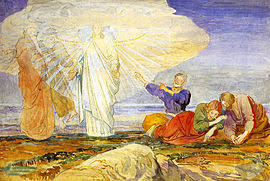
This letter was written at a time when folks were beginning to question whether Jesus was coming back at all.  It had been much longer than anyone anticipated having to wait.  Many of the original apostles had already died, and people remembered that in the stories they told, that Jesus had told the apostles that he would return during their lifetimes.  People were wondering whether they really needed to care about how they lived, if Jesus wasn’t coming back, if there was to be no judgement.  Some preachers - who both Paul and Peter denounced as False Teachers - were taking advantage of these doubts, telling the churches that prophecy was chancy at best and that they need not consider scripture to be truly inspired by God.  And Peter responds saying,  Don’t listen to them. We did not make this stuff up!  I was there!  I saw Moses and Elijah speaking with Jesus, and Jesus transfigured, gleaming!  I heard the voice from heaven saying “This is my dearly loved Son, with whom I am well-pleased.  And I heard the prophecies.  I heard Jesus speak of his return, and of the coming judgment. I am hear to tell you that prophecies are not stories invented by humans, but are truths given to them to speak by God through the Holy Spirit.   

People were getting discouraged.  The world was in a shambles. Wars and injustice everywhere.  No matter how much they preached the Good News, no matter how many hungry they fed or homeless they housed or demons they cast out, there were always more.  They couldn’t seem to make a real difference in the way humanity chose to live.   And Jesus hasn’t come back yet.  They are still waiting.  They were sure he would be here by now.   So when false teachers said, “Where is the promise of his coming? After all, nothing has changed—not since the beginning of creation, nor even since the ancestors died.” (2 Peter 3:4)   the people started to wonder.  Why should we even bother?  

We’ve heard that same question.  Maybe we’ve even asked it ourselves.  We know that countless people have left the Church because the Church seems to be powerless against the evils of the world.   That trend began among young people  in the 1960s and 70s, the days of the Civil Rights Movement and the War in Vietnam, and comparatively few who left at that time returned, or brought their children.  More have left and continue to leave because the Church excludes their friends or themselves over issues of gender identity or sexual orientation.  So today we look around and see the empty seats.  We worry that the Church might be dying.  And the false teachers continue to say “What’s the point?  The Church is impotent against injustice at best, and a collaborator at worst.” 

There are those who leave the Church because they lose faith in God’s goodness in the face of evil and suffering.  If we are to be rewarded for our faithfulness, then why do good Christians suffer from cancer?  Why do innocent children die?  Why do fires and floods do such terrible damage to homes and churches and take so many lives?  When good people and bad people alike suffer these bad things, why bother to be good?  When we can see evil people prosper and good people suffer, why should we be good?  

In the 3rd chapter of this letter, Peter reminds the people “that with the Lord a single day is like a thousand years and a thousand years are like a single day. The Lord isn’t slow to keep his promise, as some think of slowness, but he is patient toward you, not wanting anyone to perish but all to change their hearts and lives.”  He describes the judgement day as a day when all evil will be exposed and destroyed, and says, “11 Since everything will be destroyed in this way, what sort of people ought you to be? You must live holy and godly lives, 12 waiting for and hastening the coming day of God.  14 Therefore, dear friends, while you are waiting for these things to happen, make every effort to be found by him in peace—pure and faultless. 15 Consider the patience of our Lord to be salvation. 

Consider the patience of the Lord to be salvation.  How very good is it to know that we all are given the opportunity to change our lives and become the kind of people God desires us to be.  For “By his divine power the Lord has given us everything we need for life and godliness through the knowledge of the one who called us by his own honor and glory. This is why you must make every effort to add moral excellence to your faith; and to moral excellence, knowledge; and to knowledge, self-control; and to self-control, endurance; and to endurance, godliness; and to godliness, affection for others; and to affection for others, love. If all these are yours and they are growing in you, they’ll keep you from becoming inactive and unfruitful in the knowledge of our Lord Jesus Christ.”  (2 Peter 1:3-8)

Peter said, “ I’ll keep reminding you about these things, although you already know them and stand secure in the truth you have. 13 I think it’s right that I keep stirring up your memory, as long as I’m alive.” (2 Peter 1:12-13)   To the end of his life, Peter kept telling the story of Jesus as he knew it, as he himself witnessed it.   He was a reliable witness, and he loved to tell the story.

I love to tell the story - not just the story of Jesus’ life, death and resurrection, but the story of how Jesus works in my life today.  How hearing his commandments and trying to live by them has changed my life today.  How I had left the church of my upbringing at age 18, was not part of this church or any other for the next 25 years, but I learned about a loving, forgiving God in a 12 Step program and then searched for and  found a church where I was nurtured and loved, in Jesus name.  I love to tell the story of how I always know Jesus is walking with me - whether I’m going through good times or a tragedy, I am never alone.  Never.  Because my brother Jesus is always there, always holding my hand, always providing a willing shoulder for me to lean on.   I know that in the Church universal there are all kinds of people, but that the head of the whole Church is Jesus the Christ and it is his example I need to make my model, not that of any human, for we are prone to error.  

I have witnessed God’s love, manifest through Jesus Christ, with my own eyes, felt it with my own heart, known it in the darkest times and in the brightest.  And I love to tell that story to any who will listen.

When you go from this place today, I ask you to please - be reliable witnesses!  Tell the story - your story.  Share the truth of God’s glory as it has come to you in your own life and  your own experiences.   Go out, and tell the story of Jesus and his love!  

Sunday, February 16, 2020

God's Fields


Scripture. 1 Corinthians 3:1-9 CEB

Brothers and sisters, I couldn’t talk to you like spiritual people but like unspiritual people, like babies in Christ. I gave you milk tom drink instead of solid food, because you weren’t up to it yet. Now you are still not up to it because you are still unspiritual. When jealousy and fighting exist between you, aren’t you unspiritual and living by human standards? When someone says, “I belong to Paul,” and someone else says, “I belong to Apollos,” aren’t you acting like people without the Spirit? After all, what is Apollos? What is Paul? They are servants who helped you to believe. Each one had a role given to them by the Lord: I planted, Apollos watered, but God made it grow. Because of this, neither the one who plants nor the one who waters is anything, but the only one who is anything is God who makes it grow. The one who plants and the one who waters work together, but each one will receive their own reward for their own labor. We are God’s coworkers, and you are God’s field, God’s building.

***********************************************

I may have mentioned before that my church calendar has a list of things I need  to consider when planning worship and sermons on any given Sunday.  First, of course, the whatever Sunday of the liturgical year it is - today is the 6th Sunday after the Epiphany.  Then national and international days to recognize - like Scout Sunday and Earth Stewardship Sunday and MLK Sunday.  Then denominational items of interest or importance, like today’s Special Offering for Week of Compassion.  Then congregational events, like the Installation of Officers, which go straight to the top of my list.  Finally, there are special weeks when a particular topic or cause that is important to me is being lifted up by one of the clergy groups I belong to.  This week is what I have called in the past “Science Sunday” but is actually known as Evolution Sunday, when we are called upon to discuss the relationship between religion and science.  This year the particular focus for Evolution Sunday is “how we can work together to deal with the problems of the climate crisis”.   So I have all of these things to consider alongside of whatever the readings are.  

This week seemed pretty easy to me.  Paul is talking about God’s fields.  We are an agricultural community.  Agriculture is being affected adversely by climate change.  But it’s kind of a stretch, because Paul was talking about church unity.  We'll see how that works out.

For several years I went to Sacramento every June to participate in a lobbying effort with California Interfaith Power & Light,  a network of religious communities committed to being faithful stewards of Creation by responding to global warming through the promotion of energy conservation, energy efficiency and renewable energy.  On my first trip I saw the Central Valley of California for the first time ever.  This photo is what it looks like from the air, and I was blown away by the beauty below me.  Flying over Southern California is nothing like this.  That’s all buildings and mountains and desert.  But this . . . Every trip I would glue myself to the window in the plane so I wouldn’t miss one mile of this beauty.   Then I moved here and discovered the fields and orchards and vineyards are even more breathtakingly beautiful at ground level than then they are from the air.   Now I sit in McCoy’s in the mornings and listen to a group of men talk about their crops, problems and worries and solutions.  They all breathed a little easier for a minute when the drought broke, but anyone who has ever lived or worked on a farm knows the worries never really stop - getting enough rain but not too much, the temperatures being just right for particular crops, keeping the birds out and the bees in.  And market conditions.   As conditions change, so do the crops that are planted.  As times and technology change, so do the methods used to plant and grow and harvest the crops.    And people tend not to agree about how to deal with changing situations, as can easily be seen by how violently people disagree over climate change, its causes and potential solutions.  I’m thinking the cause is not as important as the solutions.  We can worry about blame after we do what we can to fix the problem.  Not enough rain and snow to provide the water we need?  Don’t care why.  We just need to work together to figure out how to get by with less water so those fields and orchards and vineyards can continue to bless us with food and beauty.   

The people in Corinth were having disagreements - which seems kind of standard for the church in Corinth.  They were divided over lots of things, but in this particular passage they were arguing over which preacher/pastor their loyalty should go to.  

Have you ever seen what happens when the person who started a successful ministry in the church has to step aside and watch someone else take it over?  In way too many cases, the planter tries to control every thing that the new person does with her program - and even tries to force them to keep it exactly as it was.  Because after all, they developed it.  They believe they know best what is needed, and they don’t see any need for change.  Sometimes the congregation will take sides and argue over who is the best at running the program. This sometimes also happens when a new pastor is called, especially when the previous pastor was the church planter or had been there for decades.   

Some of the church members wrote to Paul to complain about what was going on.  And Paul wrote back, “Seriously people?  This is what’s important to you?  This is not how adults in the faith behave, with fighting and division between them.  You are still unspiritual in your behavior, and you need to grow up.   When you take sides and argue in this way you are acting like people without the Spirit.  Here is what you need to know.  Neither Paul nor Apollos is important here, but only God.  You need to know that “I planted, Apollos watered, but God made it grow.”   

In today’s church - and I am not talking about this particular congregation, but in general - splits can happen over something that seems as trivial as what color the new carpet should be.  (and in case you are wondering, our new carpet will be almost exactly the same color it is now.)   It’s usually not really about the carpet, though.   It’s about control.  Who has the control over the congregation.  Who gets their way.  Each side in any controversy fully believes that they know what is right for the congregation.   

Our denomination, the Christian Church (Disciples of Christ) has split a number of times. One of the most famous was over how we do music in worship.  “The controversy over musical instruments began in 1860, when some congregations introduced organs, traditionally associated with wealthier, denominational churches.  More basic were the underlying approaches to Biblical interpretation.  The Churches of Christ permitted only those practices found in accounts of New Testament worship. They could find no New Testament documentation of the use of instrumental music in worship. The Disciples, by contrast, considered permissible any practices that the New Testament did not expressly forbid. While music and the approach to missionary work were the most visible issues, there were also some deeper ones. The process that led to the separation begun just prior to the American Civil War."  There are those who believe the issues of slavery and States Rights were almost equally to blame for the split as organ music.   (https://en.wikipedia.org/wiki/Christian_Church_(Disciples_of_Christ)).  More recently we have fallen out and lost congregations over such issues as whether the Bible should be interpreted literally and who is welcome in our churches.   

It is sad that a movement begun over the desire for Christian unity should split over, well, anything.   It is sad that anyone ever says things like, “If you are really a Christian you must believe this particular thing or take that particular action or belong to this or that political party.”  It is sad that we cannot, as a church and as a nation, agree to disagree on trivial things like carpet color and major items like climate change.  It is a shame we can’t just go forward to make the world a better place without arguing over how it got in this shape in the first place.  

I heard an interview on the radio last Sunday morning with a song writer (whose name I didn’t get) who was talking about how important caring for the environment is to him, and he said, “If we want to see change, we have to take action.  No pointing fingers or asking why someone else isn’t doing something,  WE have to take action.  And it doesn’t have to be a big thing,  Recycle more intentionally.  Change your diet.  Buy locally.  Use native plants.  I like that.  I like the idea of individually taking responsibility for whatever small things we can do rather than waiting for some one to lead us in some giant effort.  It doesn’t matter what kind of change we want to see, or in what field of effort we want that change to happen, If we want to see change, we have to take action.

Paul said about himself and Apollos, "The one who plants and the one who waters work together, but each one will receive their own reward for their own labor.  We are God’s coworkers, and you are God’s field.”  

We are God’s field.  We each have been planted and watered by others, but God is the one who makes us grow.  And we are God’s co-workers in that field.  We each individually get to plant the seeds of God’s love and water those seeds with the example of our lives.  We individually get to take the kind of actions that spiritual adults take, not fighting or looking to be right, but treating one another with respect, working toward justice in whatever way we believe is right - and then stand back and let God grow our crop, so that God’s kingdom may flourish on earth, as it does in heaven.

Sunday, February 9, 2020

Why are we here?


 Scripture Matthew 5:13-20.    The Message.   

“Let me tell you why you are here. You’re here to be salt-seasoning that brings out the God-flavors of this earth. If you lose your saltiness, how will people taste godliness? You’ve lost your usefulness and will end up in the garbage.
14-16 “Here’s another way to put it: You’re here to be light, bringing out the God-colors in the world. God is not a secret to be kept. We’re going public with this, as public as a city on a hill. If I make you light-bearers, you don’t think I’m going to hide you under a bucket, do you? I’m putting you on a light stand. Now that I’ve put you there on a hilltop, on a light stand—shine! Keep open house; be generous with your lives. By opening up to others, you’ll prompt people to open up with God, this generous Father in heaven.
17-18 “Don’t suppose for a minute that I have come to demolish the Scriptures—either God’s Law or the Prophets. I’m not here to demolish but to complete. I am going to put it all together, pull it all together in a vast panorama. God’s Law is more real and lasting than the stars in the sky and the ground at your feet. Long after stars burn out and earth wears out, God’s Law will be alive and working.
19-20 “Trivialize even the smallest item in God’s Law and you will only have trivialized yourself. But take it seriously, show the way for others, and you will find honor in the kingdom. Unless you do far better than the Pharisees in the matters of right living, you won’t know the first thing about entering the kingdom.

**********************************************************

Why are we here?   Seems like a silly question, doesn’t it?  In meetings I attend we have a number of readings at the beginning of each meeting.  One is titled “Why are we here?” Inevitably, some smart aleck will pipe up with, “Because it’s Sunday!”  Which, of course, is not the point of the reading at all.  But, really, when you think about it, we’re all here because it’s Sunday.  Some of us are here off and on during the week, but for the most part - it’s Sunday morning, and this is what we do on Sunday morning. 

This week I chose to use the Message version for our Scripture reading.  As many of you know, it is not my favorite because it is paraphrased and I tend to prefer a more nearly accurate translation from the original language.  But sometimes Eugene Peterson way words a passage or phrase that resonates strongly with me, and then I want to share that with you all.  

He begins, of course, by answering that question.  Let me tell you why you’re here.”  “You’re here to be the salt-seasoning that brings out the God flavors of the earth.” And “You’re here to be light, bringing out the God-colors in the world.  Preachers tend to get carried away expounding on un-salty salt and lamps covered up by buckets, but we could just pay attention to these two phrases.  God brings flavor to the earth.  God brings color, beauty to the world.  And these make sense.  Homemade soup is wonderful just as it is.  It is better, tastier, more satisfying with salt added.  And while the night time is lovely, the beauty of the earth, the colors of nature, can best be seen and experienced in the light of day. Even the night sky is beautiful only because of the lights that we can see in it - brightly shining stars and planets.   Life without God in it, that is to say, a life in which we do not pay attention to God, can be very nice.  But life with God in it, a life in which we allow God to be an active participant, changes what was very nice into something amazing.   We are here to let other people know that . . . in words if necessary, but mostly through how we are with others, in the example of our lives.  If we are cheerful and kind, generous with our caring and our time, if we speak well of others, and work at kindness even in the face of rudeness and anger . . . if through our lives people can see God’s hand, then we are doing what we are here to do.  Bearing God’s light-bearers, bringing God’s light into the world, is why we are here.

The salt and light portions of this passage are significant and important parts of this passage, and like many preachers I have devoted entire sermons just to these two things.  But wait, there’s more!  There’s the whole “completing God’s law” part.   Jesus says, ““Don’t suppose for a minute that I have come to demolish the Scriptures—either God’s Law or the Prophets. I’m not here to demolish but to complete.”  This part can be problematic because Jesus kept fussing at the Pharisees for their insistence on adhering to the letter of the law even when that kept them from fulfilling the intent of the law - like saying it is unlawful to heal on the Sabbath, thus forcing someone to suffer pain or illness longer than necessary. So why on earth would he say (according to the New Revised Standard Version) “… whoever breaks one of the least of these commandments, and teaches others to do the same, will be called least in the kingdom of heaven. . .” .   It seems a bit of a contradiction and a problem for us.  Because you know, there are a lot of those 613 laws that we definitely do not follow.  We break dietary laws at pretty much every meal.  We do not stone people to death for blasphemy.  We don’t stone people to death, period.  We work on the Sabbath all the time.  We believe slavery is immoral, so we just ignore all the laws that tell us how to treat our slaves.  Women are no longer considered property, so many of the laws regulating the behavior of women are likewise ignored.   This present reality makes the whole “whoever breaks one of the least of these commandments” bit worrisome.

In the Message Version Peterson chose to phrase it this way.   Trivialize even the smallest item in God’s Law and you will only have trivialized yourself. But take it seriously, show the way for others, and you will find honor in the kingdom.
This is helpful. This is really very helpful.  Scholars - Christian and Jewish alike -  break the 10 Commandments into 2 parts.  Commandments one through four deal with how to love God.  Commandments five through ten tell us how to love one another.  This is why Jesus spoke of the greatest commandment and the second greatest, because all of the other laws relate to one or the other of these, providing details on how one should do these things.  So when Jesus fussed at the Pharisees for their rigid adherence to the letter of the Law, it was not because the Law shouldn’t inform their lives, but because they had forgotten the purpose of the Law.  They were obedient, but not necessarily living right.  It is better, for example, to heal on the Sabbath than to allow one of God’s children to suffer even one more hour.  This honors God’s intentions for us to love one another.  Healing on the Sabbath does not in any way trivialize the Law, although it does break the literal commandment to do no work on the Sabbath.   So Jesus said to his followers, “Unless you do far better than the Pharisees in the matters of right living, you won’t know the first thing about entering the kingdom. 

When we look at all those Laws from this perspective we come to realize that it is not a matter, as some would argue, of choosing which laws to follow and which laws we can safely ignore as not relevant to today’s society.  It is more a matter of determining in what way we should perceive any specific law when seen through the lens of the two greatest commandments upon which all of the others depend - Love God and Love One Another.  Some laws were written to protect the nomadic society from illness - don’t eat shellfish or pork or carrion eaters.  Some laws were concerned with the just treatment of people who could easily become oppressed - slaves, resident aliens, widows and orphans.  Some specify how those who could not live within society should be punished - thieves, adulterers, murderers, blasphemers.  The proper treatment of wives and concubines is spelled out - the Hebrew people were not monogamous.  We might have a problem with that, but it was the best solution for women and children who needed the support and protection of a family unit.  It was one of the ways in which the weaker members of society were protected.  The intent of so much of the Law is protecting the weak from those who would oppress, keeping the people alive and well, keeping the people working together as a community, caring for and about one another.   

Jesus said, “Don’t suppose for a minute that I have come to demolish the Scriptures—either God’s Law or the Prophets. I’m not here to demolish but to complete. I am going to put it all together, pull it all together in a vast panorama. God’s Law is more real and lasting than the stars in the sky and the ground at your feet. Long after stars burn out and earth wears out, God’s Law will be alive and working. 

In Matthew 22 Jesus put it all together.  ‘Love the Lord your God with all your passion and prayer and intelligence.’ This is the most important, the first on any list. But there is a second to set alongside it: ‘Love others as well as you love yourself.’ These two commands are pegs; everything in God’s Law and the Prophets hangs from them.”  The Law, all of it, is about relationship with God and with one another.

Don’t trivialize the Law, not even the smallest item, for to do so is to trivialize yourself. Although the world has changed in the 3,400 or so years from the time the Laws were written, each and every one of those laws is important in that each and every one speaks to relationship.  Don’t worry so much about the fine details of this regulation or that one, but concern yourself with living rightly, being in right relationship with God and with each other.   If we are, in fact,  the city on the hill, the light-bearer, the salt-seasoning then the reason we are here is to bring God’s light, God’s colors, God’s flavor into every thing we touch, every action, every word.  
This instruction is not only for individuals, although Jesus was addressing his words to individuals.  It is also for the Church.  If we as church have lost our saltiness through tiredness, through being weary of the struggle just to keep going, it will be difficult to continue with our mission, which is to carry the Gospel to everyone, all the world. For the church, being the salt and the light means allowing everyone to see that, in our relationship with God and with one another we are agents of God’s love.  Being the city on the hill doesn’t mean we get to stay on the hill.  For Jesus said, “We’re going public with this.  We are to go out, shining that light on the suffering around us. We are to be God’s hands and feet in the world.  We are to be the means by which others get to taste Godliness and open themselves up to God, our loving and generous Father.   May we be renewed in our purpose, that we may regain our saltiness and let our light shine brightly from the hilltop on which Christ has placed us.  

Sunday, February 2, 2020

Asked and Answered


Scripture Micah 6:1-8    (CEB)  


1  Hear what the Lord is saying:
Arise, lay out the lawsuit before the mountains;
        let the hills hear your voice!
2  Hear, mountains, the lawsuit of the Lord!
        Hear, eternal foundations of the earth!
The Lord has a lawsuit against his people;
        with Israel he will argue.
3 “My people, what did I ever do to you?
        How have I wearied you? Answer me!
4 I brought you up out of the land of Egypt;
        I redeemed you from the house of slavery.
        I sent Moses, Aaron, and Miriam before you.
5 My people, remember what Moab’s King Balak had planned,
        and how Balaam, Beor’s son, answered him!
        Remember everything from Shittim to Gilgal,
        that you might learn to recognize the righteous acts of the Lord!”

6 With what should I approach the Lord
        and bow down before God on high?
Should I come before him with entirely burned offerings,
        with year-old calves?
7 Will the Lord be pleased with thousands of rams,
        with many torrents of oil?
Should I give my oldest child for my crime;
        the fruit of my body for the sin of my spirit?

8 He has told you, human one, what is good and
        what the Lord requires from you:
            to do justice, embrace faithful love, and walk humbly with your God.

**********************************************************

The message title comes from my decades of legal experience. I have, after all, watched thousands of hours of TV courtroom drama from Perry Mason to JAG to all of the Law & Order series to Matlock to Boston Legal and so many others.   I always loved seeing the defense lawyer growling “asked and answered” at the prosecutor when they had just asked the totally innocent defendant the same question in a slightly different way for the 5th time.  The detectives on those programs do it too, when trying to get a confession from the accused.  For some reason people tend to believe that asking the same question in a different way will elicit a different response, maybe hoping the person they are asking will give up and agree with whatever just to get them to stop asking.   Children seem to do this instinctively.   The leaders of Israel do it here.  

Of course, this passage is not a script from a courtroom drama about criminal matters.  The lawsuit Micah is describing is more in the realm of contract law.  God made a covenant with Israel, saying “I am your God and you are my people” and wants know why they are not keeping up their end of the bargain - again.   God’s covenant with Israel had always been this,”  No matter what happened, in every situation, every time Israel strayed, God remained faithful to the covenant, even if they did not.   The prophet Micah, God’s mouthpiece, begins with God’s lament - “What have I done to you that you should turn away from me?"  and reminds them of how they were liberated from Egypt.  He said, 

My people, remember what Moab’s King Balak had planned,
        and how Balaam, Beor’s son, answered him!

What Balak had planned was to get Balaam to curse Israel so that they wouldn’t be able to defeat and over run his country, Moab, as they had the other Canaanite nations when they entered the Promised Land.  He had Balaam, a holy man, brought to him, gave him instructions, and sent him out to  curse Israel and - Three times, God stepped in to prevent evil from befalling Israel by giving Balaam the words to say.  Three times Balaam pronounced a blessing on Israel instead of a curse.  Three times Balak asked him why he was blessing Israel instead of cursing her.  Three times Balaam answered Balak, “Did I not tell you, ‘Whatever the Lord says, that is what I must do’?” 

Whatever the Lord says, that is what I must do.  See, this is the part that the leadership of Israel kept getting wrong.   They would do part of what they had been told to do.  The ritual stuff came easily to them - the fancy vestments and ritualized ceremonies, the sacrifices and tithing - they had those down.  They kept falling short on the “love one another” parts - caring for the widows and orphans who have no one to give them food and shelter.  Treating resident aliens equally under the law.   Making sure no one in their land is oppressed, that all are treated fairly, and all are afforded equal rights.  In the next few verses God will denounce those who put profit ahead of ethical behavior, and who follow the policies of kings instead of God.  

What do you want from us?  they asked.  And they offer increasingly expensive sacrifices.  And Micah answered, you know what God wants.  You have been told repeatedly.  God wants you - all of you, not your burnt offerings or incense or oil or gold or even your oldest child.  God wants you to care for each other, to help where you can, to treat others as you would be treated, to do good without bragging.    God wants you to keep the covenant and be his people, fully and unreservedly.  Asked and answered.  What God wants, what the Lord requires of you is to do justice, embrace faithful love, and walk humbly with your God.

We are coming to the time in our service when we install the Board officers, elders, deacons, and team leaders who just last week were newly elected, or re-elected for a second term, joining those leaders  were elected in previous years whose terms have not yet expired.  The words of installation are a covenant between the new leaders and the congregation, a promise made to each other and to God.  The leaders will promise to serve to the best of their ability with God’s help, the congregation will pledge eager support for God’ ministry under the leadership of those they have elected.  

Eager support - not sitting back and letting the elected leaders do everything, but offering to be helpful when help is needed.   The leaders cannot do everything - and they shouldn’t try to do everything.  All of us, everyone here, will be bound by that covenant - to serve faithfully and to eagerly support God’s ministry.   What God wants from us, requires from us, is to serve selflessly, with love and humility, doing all things in God’s name.   What God requires from us is to keep that ancient covenant - for he is our God, and we are his people.