Sunday, October 15, 2017

This Empty Feeling


Exodus 32:1-4 NRSV
32 When the people saw that Moses delayed to come down from the mountain, the people gathered around Aaron, and said to him, “Come, make gods for us, who shall go before us; as for this Moses, the man who brought us up out of the land of Egypt, we do not know what has become of him.” 2 Aaron said to them, “Take off the gold rings that are on the ears of your wives, your sons, and your daughters, and bring them to me.” 3 So all the people took off the gold rings from their ears, and brought them to Aaron. 4 He took the gold from them, formed it in a mold, and cast an image of a calf; and they said, “These are your gods, O Israel, who brought you up out of the land of Egypt!”

*********************************************************************

Timothy was in my very first Sunday School class of 2nd - 5th graders at Treasure Coast Christian Church in Port St. Lucie Florida..  And every time we read a story, like the story of Moses floating down the river in a basket, or David defeating Goliath, or Noah and the Ark, when I asked who the main character of the story was, Timothy would shout, “Jesus!”   I would have to explain that Jesus wasn’t in that story, that he would come along later in the book.  Timothy would always be a bit disappointed, because he really loved Jesus.

One of the problems we sometimes encounter is trying to lay our 21st century understandings on events that occurred long ago.  The Exodus began something like  3,500 years ago, and about nearly 1,500 years before the resurrection.  It’s hard for people of our time to wrap our minds around the way people thought, and especially, how they understood God in those days.  So we come to the story of the Golden Calf, and we try to understand why they would demand that a god be made for them.  Didn’t they understand that their God, the God of Abraham and Isaac and Jacob, couldn’t be represented by anything living.  Well, no.  They didn’t.  They didn’t have the 10 Commandments yet. They didn’t know God had a rule about that. They didn’t know a lot about their God Yahweh because they had been under Egyptian rule for some 400 years.   One of the members of my previous church used to ask me all the time, “How could they forget about God?”  

If you are not taught something, you don’t know it.  It’s not like they had books. Frankly, we don’t know a lot about how Abraham and the other Patriarchs understood God, or how they worshipped God, or what they taught their families about God.  We do know that even Jacob’s wife Rachel felt it necessary to steal the god statues from her father’s home, so she obviously didn’t understand much about Jacob’s God.  We also know that for some 400 years the tribes of Israel were ruled by people whose gods were represented by statues and paintings.  So when they started getting frightened that maybe Moses wasn’t coming back - because he’d been up on that mountain a long time - it makes sense that they would want something they could see and touch and understand.  So Aaron had them give up all their jewelry, and from those offerings he made a figure in the shape of a calf.    Today’s reading cut off with Aaron presenting the calf to the people, and saying, “Here are your gods.”  It goes on to say, “When Aaron saw this, he built an altar before it; and Aaron made proclamation and said, “Tomorrow shall be a festival to the Lord.”   6 They rose early the next day, and offered burnt offerings and brought sacrifices of well-being; and the people sat down to eat and drink, and rose up to revel.”  The Hebrew word translated here as Lord is a word that is used only to describe the God of Abraham, not any of the other gods who are mentioned in scripture.   In their minds, this calf is the representation of their God, the one that Moses was talking to.  Here is a figure to adore, and to make sacrifices in front of, and celebrate over.  This is what they were used to, so this is what they wanted.   They were shocked (and terrified) when Moses came back with the word that God was angry with them.  “But, Moses, we’ve always done it this way.”   Well, Israel, it’s time for something new.

What they did have, which is very clear from this passage, is a need for God.  In our Wednesday Bible Study we were talking about the practice of the ancient Greeks of putting an altar to The Unknown God in their temples.   Our assumption is that they knew something was missing from their pantheon of gods, so they always included this one that they didn’t know.  We talked about how that indicated that they had an empty feeling - a God shaped hole - within them that needed to be filled, and that the gods they knew weren’t sufficient.  

So the people of Israel cheerfully gave up their golden earrings - the accumulated wealth of their family - so Aaron could make the calf.   They literally gave it up for God.  They were happy to donate what had taken possibly years to acquire, in order to have a god, in order to fill that empty place inside of them.   They gave cheerfully, and selflessly, and worshipped this God they didn’t understand the best way they knew how.  How were they to know this is not what God required of them?  (They weren’t.  No one had told them yet.  Moses was still on the mountain.)

What is this empty feeling?  Even those of us who are Christians and belong to a church and show up for worship services regularly and tithe and do all that stuff,  still sometimes find ourselves grappling with that empty feeling.  Sometimes we try to fill it with stuff - with food or spending or activities or people or exercising.  Sometimes we try to fill it with volunteering.  We believe ourselves to be giving selflessly, giving of ourselves with no expectation of reward.   

This week on Facebook my friend Frank Lopez started a discussion asking whether selflessness and selfishness were truly different things, or whether they were, in fact, the same thing.  His point was this - that even if we are giving of ourselves, our money, our time and talents with no expectation of recognition or reward;  even if we do these things anonymously so no one can possibly know who it was gave or did that good thing; we are still getting something out of it because, quite honestly, it feels good to give, to volunteer, to end the day knowing we have done something that will make life better for someone.   So, are we truly being selfless, or must we call these actions selfish?    I don’t have an answer for you.  We each get to grapple with that one for ourselves.  I will tell you though, that I don’t mind a bit selfishly enjoying the good feeling that comes when someone else benefits from whatever it is I have done.   

The people of Israel gave generously in order to have a focus for their worship - a calf.  It was the wrong thing to do, but the motivation came from that empty feeling they had, that God shaped hole within that required a focus for their worship, for their love, for their devotion.   

If I asked Timothy what was the important thing to remember from this Scripture lesson, I’m pretty sure he would have smiled and shouted, “Jesus!”  For Timothy, everything was about Jesus.   And he wouldn’t be wrong.  John Calvin said, “We ought to read the Scriptures with the express design of finding Christ in them.”   So where do we find the Christ in this passage?  

The people of Israel felt empty inside, alone, deserted by Moses, fearful and uncertain.  And because of these feelings, they reached out to Aaron, the brother of Moses, asking him for something that would fill that hole, that empty place.  They were in a hurry.  They didn’t know how long Moses would take on that mountain.  They didn’t know or trust either Moses or God quite enough to just wait, to just have faith that sooner or later they would receive what they need.   They were willing to give all they had to fill that hole, but they weren’t willing to simply wait for what they needed to come to them.   

If we would fill that empty space, that God shaped hole that comes to everyone now and then, we will wait.  We will have faith that God is there, even when we feel alone.  Even when we feel deserted.  We will remember that after centuries of living in slavery, God saved the Children of Abraham, and led them out of captivity.  And we will remember that after many more centuries, when the people of the world were still living in sin and solitude, God sent Jesus the Christ to teach and save the entire world, to fill that God shaped hole in all of humanity.  And because we remember these things, because we believe that Jesus is the Christ, we will wait for the right time.  We will be patient, knowing that whatever we need to fill that empty place will come, it will be provided by God, when the time is right.  And while we wait, we will continue to offer our gifts and talents to the Lord our God, so that they may be used in the best possible ways, to further God’s work in the world, bringing peace and understanding to our neighbors.  


Sunday, October 8, 2017

That's what He said.


Exodus 20:1-4, 7-10a, 12-20 NRSV


20 Then God spoke all these words:
2 I am the Lord your God, who brought you out of the land of Egypt, out of the house of slavery; 3 you shall have no other gods before me.
4 You shall not make for yourself an idol, whether in the form of anything that is in heaven above, or that is on the earth beneath, or that is in the water under the earth.
 7 You shall not make wrongful use of the name of the Lord your God, for the Lord will not acquit anyone who misuses his name.
8 Remember the sabbath day, and keep it holy. 9 Six days you shall labor and do all your work. 10 But the seventh day is a sabbath to the Lord your God; you shall not do any work
12 Honor your father and your mother, so that your days may be long in the land that the Lord your God is giving you.
13 You shall not murder.
14 You shall not commit adultery.
15 You shall not steal.
16 You shall not bear false witness against your neighbor.
17 You shall not covet your neighbor’s house; you shall not covet your neighbor’s wife, or male or female slave, or ox, or donkey, or anything that belongs to your neighbor.
18 When all the people witnessed the thunder and lightning, the sound of the trumpet, and the mountain smoking, they were afraid and trembled and stood at a distance, 19 and said to Moses, “You speak to us, and we will listen; but do not let God speak to us, or we will die.” 20 Moses said to the people, “Do not be afraid; for God has come only to test you and to put the fear of him upon you so that you do not sin.”

********************************************************************

Last Saturday morning a bunch of people showed up at my house, bringing with them entirely too much delicious food, to talk about Church.  I divided them into three groups and gave each group a question.  After a while I switched the questions, so each group got to discuss each question.  One of those questions was “What does stewardship mean to you?”  In addition to the expected responses about money, time and talents, here is what the note takers for the groups wrote down:
  • Part of our relationship with God
  • Stewardship of the earth
  • Taking care of our bodies
  • Taking care of what God has given us
  • Caring for others
  • Serving others

Today we’ll talk a bit about those answers.  And don’t worry,  we’ll be talking about the other questions over the next weeks and months.

And before you ask what on earth the Ten Commandments have to do with Stewardship, in the Gospel according to Matthew, Chapter 22, a lawyer asked Jesus, “36 “Teacher, which commandment in the law is the greatest?” 37 He said to him, “‘You shall love the Lord your God with all your heart, and with all your soul, and with all your mind.’ 38 This is the greatest and first commandment. 39 And a second is like it: ‘You shall love your neighbor as yourself.’ 40 On these two commandments hang all the law and the prophets.”
On these two commandments hang all the law and the prophets.  These Ten Commandments tell us very precisely how we are to love God, and our neighbor.   The other 630+ laws are simply expansions on these 10, so that the people would have no question about what is and is not lawful.  Even today there are rabbis who continuously go through the Law and add to it or make revisions to bring it up to date with current realities.  For example, is putting is false teeth work?  Can you do it on the Sabbath?  (Yes, it is. And no, you may not do that on Sabbath. You have to put them in before sundown on Friday if you want to eat anything but soup on Saturday.)  How about running a search on Google?  Is it acceptable if you are looking for answers to religious questions?  I do not know, and I am very glad I don’t have to, since my understanding of keeping the Sabbath holy is very different from the understanding my friend Orthodox Jewish friend in Jerusalem has of that same commandment.  

So, if we understand stewardship to include caring for our ourselves and our neighbors, and as part of our relationship with God, clearly these Ten Commandments speak to us about Stewardship, because they are all about how to love our God and our neighbors.  If I love my neighbor, I will not accuse him of things I know he didn’t do, or that I’m not sure about.  If I love my neighbor, I will want only good things for her.  I will not steal from her, or be angry with her because she has things I wish I had.  I will be happy for her successes.  If I love my neighbor, I will do the best I can to make sure the elder folks in my community are cared for, as if they are my own parents.  If I truly love my neighbor, I will do my best to keep them safe.

Part of good stewardship is teaching others how to live.  We do that here, in our church.  We teach people how to love and how to share their love with others, even with people they don’t like.  Even with people they are angry at.  And when we fail at that, we have failed to love them properly.  We have failed to care for them properly.  We have failed to follow the commandments God has given us.

It would be impossible to stand here today, talking about the commandments, looking up there at the Sixth Commandment, and not talk about what happened last Sunday.  We cannot look at the words, “You shall not murder,” and not think about Stephen Paddock going into his hotel room with 23 firearms and a lot of ammunition, and deliberately firing hundreds of rounds into a crowd of people enjoying a concert.  We cannot look at the words, “You shall not murder,” without thinking of the 58 persons who were killed, and the hundreds who were wounded.  I cannot think of his actions without wondering how we went wrong.  Somehow, somewhere, the message that murder is wrong didn’t get through, or at least, it stopped connecting for Mr. Paddock last Sunday.   A week later, investigators still don’t know why he did this thing.   He has no history of mental illness, of domestic violence, of any of the signs of a disturbed mind or internalized rage.  No one seems to know, or to understand what was going through his mind, or what triggered his actions.   

Somehow he got the message that it is ok to kill people.   Even though God’s Commandment clearly says “You shall not murder.”  Even though the laws of the land say the same thing.  Even though he had to know, from watching TV if nothing else, that his actions were certain to result in his own death, either by his own hand or at the hands of a police officer - who would then have to live with the knowledge that he or she had taken a life.   Somehow, despite all of that, he got the message that it was ok to take, not one, but dozens of lives,

I think, whatever his motives may have been, ultimately, it was our failure.  We, the Church, failed to reach him. Failed to teach him.  Failed to love him, and failed at teaching him to love.  


And he isn’t the only one we have failed.   There seems to be a growing belief that if someone disagrees with you, it’s ok to hit them.   It’s ok to call them names, or damage their property.  

Monday evening I attended the City Council meeting.  There were a number of very unhappy citizens there, worried about the crime rate in our city, worried about gangs coming into our city, worried about the violence that has taken lives here.  I heard those people say, “What are you doing?  Why aren’t you fixing it?  We need more police to prevent these crimes.”  I heard one pastor say, “Hey, the churches, we’re out there working with the people.  Come join us, help make a difference.”  And they continued to complain, and to point fingers.  I stood up and asked, “When the churches are out there working to heal our neighborhoods, where are you?  What are you doing to make a difference?”      

Now I know that some of those folks go to churches in town. I am sure that some of them participate in various helping programs at their churches, and support charitable causes.  That’s good.  That’s a start.  But the thing that has to be done is to root out the anger, the hatred, the bitterness within each heart - within each of our own hearts.   The thing that has to be done is to change our society, so that it is no longer ok to hit someone who disagrees, or call him names, or damage her property.   It is our job as Christians to change the world, the whole world.  For Jesus was sent to save the whole world - all of it.  To reconcile all of the world with God and with each other.  And Jesus left us behind with instructions to do that.  

It’s our job to love our neighbors.  All of our neighbors.  Even the angry ones.  Even the gangbangers.  Even the people who stand up in City Council meetings and say, “I’m locked and loaded.  Let them try to come to my house.”  and “I guess I need to take matters into my own hands, then.”  It’s our job to teach them that’s not the right way to do this.  Part of good stewardship is taking care of our community, and the people in it.  Not just feeding them, and housing them, but helping them to reconcile with whomever they are angry with.  Giving hope where there is none.  Helping people understand that they are not alone, that someone cares about them, that someone will listen to them.    

Our theme this month is “Journey to Generosity.”  That journey is not just toward generosity of finances and other gifts to the church, but also toward generosity of spirit.  It is a journey toward forgiveness.  It is a journey toward willingness to reach out to people we may not agree with, or even like very much, to assist them in healing.  To assist them in learning how to love their neighbor.   To bring them hope.   To help them heal.


Stewardship is about being in relationship with God, and with each other.   When we go from this place today, let us be good stewards.  Let us share God’s love by truly caring for everyone we meet.  Let us spread joy and hope through our love of our neighbors, so that where ever we have been, peace follows.  

Sunday, October 1, 2017

Bread and Water

Scripture Reading  Exodus 17:1-7    (CEB)  


17 The whole Israelite community broke camp and set out from the Sin desert to continue their journey, as the Lord commanded. They set up their camp at Rephidim, but there was no water for the people to drink. 2 The people argued with Moses and said, “Give us water to drink.”
Moses said to them, “Why are you arguing with me? Why are you testing the Lord?”
3 But the people were very thirsty for water there, and they complained to Moses, “Why did you bring us out of Egypt to kill us, our children, and our livestock with thirst?”
4 So Moses cried out to the Lord, “What should I do with this people? They are getting ready to stone me.”
5 The Lord said to Moses, “Go on ahead of the people, and take some of Israel’s elders with you. Take in your hand the shepherd’s rod that you used to strike the Nile River, and go. 6 I’ll be standing there in front of you on the rock at Horeb. Hit the rock. Water will come out of it, and the people will be able to drink.” Moses did so while Israel’s elders watched. 7 He called the place Massah and Meribah because the Israelites argued with and tested the Lord, asking, “Is the Lord really with us or not?”

********************************************************************
It’s October!  Stewardship Month!  Our theme for the month is “Journey to Generosity.”  All month we will be talking about stewardship and giving - of money and of time and talents.  At the end of the month we will ask you to bring in your pledges - cards on which you have indicated how  you will contribute to this church and our ministries, whether money or time or talents or some combination of the three.

This week we are collecting a special offering for the Disciples Pro-Reconciliation and Anti-racism mission imperative.

AND today there is also a special offering request for Bread for the World, so that we can help feed people around the world.

All of these things relate to each other . . .   They are all about asking for money

Today is also world communion Sunday.

When we add that to the mix, it changes everything.  Now, all of these things are about loving the neighbor.  

In today’s scripture reading Moses was not feeling the love.  He “cried out to the Lord, “What should I do with this people? They are getting ready to stone me.”    They had moved from one camping place to another and there was no water at the new place.  Lack of water is a  major problem because it wasn’t just a whole lot of people traveling together.  There were herds and flocks to be cared for, which also required water - a lot of water.   And they were worried.  They were pretty sure they were going to die of thirst in the wilderness, and obviously it was all Moses’ fault.

These people were pretty good at forgetting.  In Chapter 16 of Exodus they had complained to Moses that they were going to starve to death and it was his fault for bringing them out of Egypt where, they claimed, there was always plenty of food to eat.  And God responded by providing manna in the morning and quails at night - every morning, and every night.  That didn’t stop when they  moved.  That outpouring of food and love from the Lord would continue throughout they entire journey, the whole forty years they spent on their way. 

But now they are out of water.  And once again they wished they were back in Egypt, where, they claimed, there was always plenty of water to drink.   And God responds by having Moses strike a rock with his staff, and caused sweet water to flow out of the rock.   He did this in front of witnesses - the elders and leaders of all the tribes of Israel, men who were trusted by the people - so there could be no question but that God provided the water, using Moses and his staff as tools to make the miracle happen.  God had made pretty good use of that staff.  It turned into a snake while Moses was confronting the Pharaoh.  It was the tool God used to make the path through the sea so the people could safely cross.  To the people of Israel, Moses’ staff was a symbol of God’s presence and power.   

Every time things got a little rough along the way, the people forgot what God had already done for them.  They mis-remembered their past as being soft and comfortable.  They forgot about their slavery.  They forgot about the time when their baby boys had been killed.  They forgot about the Pharaoh forcing them to to make bricks while withholding the materials they needed.  And if they didn’t get the bricks made, they didn’t get paid, they didn’t get food, they didn’t get water.   They forgot all those things.  And they forgot what God had done for them. They forgot about where the manna and the quails came from every single day.  They lacked faith that God would continue to provide for them, no matter how much proof they had.

And we can sort of excuse them, maybe.  After all, they had sort of fallen away from an understanding of God over the 400 or so years they had been in Egypt.   They weren’t used to living by the Law that Moses brought down from the mountain.  It didn’t yet have centuries of tradition behind it the way it would by the time of Jesus.  They weren’t used to having a steadfast, faithful and loving God in their lives.  They were used to the gods of Egypt, who had to be placated constantly and whose love had to be purchased repeatedly.   They were used to gods who asked their worshippers, “So, what have you done for me lately?” not one who would pour blessings upon them for no reason other than because they were God’s own beloved children.   This was just such a foreign concept to them - that this God they didn’t know well at all would pour out abundant bread and water in the midst of the wilderness, in the midst of a place where no bread and no water could be found.  And that God would require nothing of them in return for that abundance, except to care for one another in accordance with the Laws that Moses had brought to them.  This was all very new to them.  So maybe we can sort of understand why they had so much trouble trusting God to continue to provide for them. 

This isn’t new to us, however.  We should know these things.  We shouldn’t have any trouble having faith that God will provide all of our needs.  We should be well aware that nothing is impossible with God.  If God wills it, it will happen, one way or another.  That does not mean, however, that everything we need to do the work this congregation - or any congregation - does will simply fall into our laps.  God did expect the Israelites to go and collect the manna to make into bread, to out and catch the quails to cook for their dinners. God put the opportunities in front of them and anticipated that they would do what was necessary to make best use of those opportunities.  God expects that, in gratitude for all the blessings received, God’s people will care for one another - that the able bodied would take care of those less able, that adults would care for children, that adult children would care for their aging parents, that each person would watch over her neighbor to make sure they were ok.   Or, as the prophet Micah reminds us, God expects us to do justice and to love kindness, and to be humble in our walk with God.

Bread and water.  Regardless of what some dietitians might say, these are the two things that we absolutely need to live.   We receive these things in abundance, as did the people of Israel in their journey to the promised land.  And we share these things that we have in abundance, because that is what God requires of us.  

Some of us have enough money that we can share it with others.  We might be pretty comfortable and don’t worry about making donations of 10% or more of what we have, or we might not have a lot to give.  We might find 10% is challenge, or even a hardship.  But every little bit given to a cause that matters to you helps.  One Dollar helps.  If you give One Dollar to the Reconciliation Offering, or Bread for the World, or Week of Compassion - that One Dollar will be added to lots of other One Dollars and together they will make a huge difference in someone’s life.   If you put One Dollar in the offering plate here every week, that’s $52.  That’s like 3 cases of copy paper!  One Dollar.  It’s a big deal.

Some are blessed with gifts - beautiful voices, the ability to dance, great talent at playing instruments, the gift of prayer or teaching or speaking, or of being an administrator, or of building and repairing things, or of coming up with brilliant crazy ideas - gifts of this nature are a blessing to share with one another in the congregation.  Some of us are blessed with an abundance of time that we can spend helping where ever we are needed - at the food pantry or Christian Cafe or doing things that are needed around the church or in some other way that makes your heart sing.   Giving of ourselves, of our gifts and talents and time, is a blessing to everyone.  

On this particular Sunday, we come together with all other Christians to share in the Lord’s Supper. On this particular Sunday, every year, no matter what our differences might be, all Christians come together around the communion table.  In some traditions there will be Elders presiding, in others only an ordained minister of that particular denomination may preside.  In some traditions they will serve wine, in others juice, in still others a choice between wine and juice. The breads will be different from country to country and congregation to congregation.  But in every congregation, today we will gather around this table, and give thanks to the Lord our God for the gift of his son, our Lord, Jesus the Christ.  In every congregation today, we will gather around this table to remember that Last Supper he shared, and share it in remembrance of his life, and his death, and his resurrection.  Regardless of our differences, today we will celebrate the gift of Our Lord’s life, together.

Before we gather around this Table, let us take time to remember the gifts of God’s grace with which we are so richly blessed . Let us take time to remember where all the gifts of resources, time and talents come from.  Let us dedicate ourselves to giving back what we have been so freely and lovingly given.  Let us pledge our lives and all that we are, to the Lord our God, from whom all things come. 


Sunday, September 17, 2017

All means ALL


Scripture: Romans 14:1-12 Common English Bible (CEB)  

14 Welcome the person who is weak in faith—but not in order to argue about differences of opinion. 2 One person believes in eating everything, while the weak person eats only vegetables. 3 Those who eat must not look down on the ones who don’t, and the ones who don’t eat must not judge the ones who do, because God has accepted them. 4 Who are you to judge someone else’s servants? They stand or fall before their own Lord (and they will stand, because the Lord has the power to make them stand). 5 One person considers some days to be more sacred than others, while another person considers all days to be the same. Each person must have their own convictions. 6 Someone who thinks that a day is sacred, thinks that way for the Lord. Those who eat, eat for the Lord, because they thank God. And those who don’t eat, don’t eat for the Lord, and they thank the Lord too. 7 We don’t live for ourselves and we don’t die for ourselves. 8 If we live, we live for the Lord, and if we die, we die for the Lord. Therefore, whether we live or die, we belong to God.9 This is why Christ died and lived: so that he might be Lord of both the dead and the living. 10 But why do you judge your brother or sister? Or why do you look down on your brother or sister? We all will stand in front of the judgment seat of God.11 Because it is written,
As I live, says the Lord, every knee will bow to me,
    and every tongue will give praise to God.

12 So then, each of us will give an account of ourselves to God.

**********************************************************

I just love the way this passage begins.  “Welcome the person who is weak in faith—but not in order to argue about differences of opinion.”   And I love the way it continues.  Some eat meat, some don’t.  Don’t judge!  Some holds certain days especially sacred, some considers every day equally sacred.   Don’t judge!  “Each person must have their own convictions.”

Just in case you are wondering, Paul has nothing against vegetarians.  Or even Vegans. Or pescatarians or carnivores.   Or people who think only certain activities are acceptable on Sunday, because the day is sacred and we should dedicate the whole entire day to worshipping the Lord (and not the NFL). Or who think every day is equally as sacred to God as every other day.  Paul is talking about the cultural clash that was inherent to the Roman church.  

Poor folks in Rome rarely got meat to eat.  They were poor.  Meat was expensive. They ate bread, onions, beans . . .  but hardly any meat.  On certain days the temples to the various gods worshipped in Rome held sacrifices, and then made that meat available to the poor.  Some folks said, “Oh, you can’t eat that because it was part of a pagan religious service!  Eating that would be like worshipping that false God.”  Other folks said, “Hey.  Meat is meat.”  And they fought in the church over that.  “Well, if you eat that pagan meat then you aren’t really a Christian.”  “But if there only is one God, then it’s just meat and anyone can eat it.”  Just to add to the problem, sometimes that meat was pork, and while some folks might not have a problem eating pork, others adhered to the Mosaic law in which the eating of pork was an abomination.  Imagine, fighting in church over whether or not to eat meat.  Silliness!  Am I right?   And yet, the church in Rome was coming to blows over it.   And Paul says, don’t judge. Both of you are doing what you do to honor God.  It is all good.   (Although I think Paul was maybe just a little judge-y when he called the people who don’t eat meat “weak.” Whatever.) 

In many cases, the arguments in those congregations were between Jewish Christians and Gentile Christians, those who believed one must adhere to the Laws of Moses in order to become Christian, and those who believed faith in God through Jesus Christ was enough.  And Paul kept saying, “All y’all, knock it off.  You are all Christians.  You all serve God.  You all do the best you know how to honor God. So stop judging each other.  That’s God’s job!” 


In our Wednesday evening study of the Book of Acts, we were asked to look at our congregation and see who is missing.  Well, maybe we weren’t asked that, exactly.  We were asked to see what was keeping us from welcoming everyone - who might not be welcome.  And, after some thought, one person said, “We’re not as white as we used to be.”  True.  This congregation was once all white.  The fact that this is no longer true is truly worthy of celebration.  It’s not as old as a lot of congregations.  I mean, yes.  This church is something like 130 years old. Even our building is over 100!.  But as regards the people worshipping here on Sunday mornings, we have this whole section over here of younger folks who show up voluntarily!  Not dragged here by parents or grandparents.   A lot of churches can’t say that.  The congregation is not as straight as it used to be, either.  Another very good thing.   And all these different people are not just pewsitters.  There are women in leadership, and gay and lesbian folks in leadership, and young people in leadership, and people of color in leadership. Not due to any deliberate or intentional “inclusiveness” program - it just happened that way.  Leaders are leaders no matter what wrapping they come in.  

That’s not to say we are perfect.  We aren’t.  We are human.  We judge.  But we are trying.  We seek to be inclusive of everyone who comes. Even if their theology differs from ours.  Even if their commitment to social justice doesn’t match ours.  Even if they voted differently.  Even if they want to do something new and different in worship - or (gasp) change the order of worship.    As we look around here, we can see there are some pretty big gaps  - some groups of people who are clearly absent.  Our building’s very structure keeps some folks away - people in wheelchairs, or and people can’t easily walk up and down steps.  We seem to be lacking young families with small children.  We don’t have a children’s Sunday school group or even a junior high group right now.  There are no homeless folks here, that I know of.   

I’m not saying we need to go out looking for homeless folks to invite to church.  Or start a children’s program with no children.  When the need arises, we’ll do it - whatever it may be.  That’s who we are.   We have a history of doing what we are called to do when the time is right.  We may not always agree on when that time is, but we do eventually do what we need do.  

Here at First Christian Church we proclaim that, “All means ALL!”   It was hard to get to that point, but we have and we are proud of that claim.  We do our best to live up to it.   However, in our denomination there are those who say that “All means ALL!” is simply a step on the way to becoming Open and Affirming, a designation for congregations who have decided through a time of discernment and prayer that all of our LGBTQ+ sisters and brothers are welcome to participate fully in the life of our congregation.  Those people believe that we don’t have the courage to take that step, and become truly welcoming.

I beg to differ.  I believe that “All means ALL” is much bigger and more inclusive than that.  And I wore my very best rainbow accessories to make a point this morning.

The rainbow happens when the white light from the sun passes through water (clouds or rain) and is divided, each color from the one next to it in the spectrum. Each wavelength has its own spot.  The rainbow is cool, because when there is a rainbow we can see all the different colors light comes in.  But when all of those light colors, and all of those differences in wavelength come together, what we get is white light -  because, white light consists of all wavelengths of visible light.  So although out there we might be young and old, white and persons of color, men and women and all the genders in between, gay and straight and all the orientations in between, citizens and aliens - documented or not - left and right and center, even vegan and carnivore . . . in here we are one congregation.  Not divided into all those different wave lengths, or groups.  We are one.  One, holy, universal, apostolic church.   In this place, the rainbow comes together.   

(And for those who are reading and not watching - at this point I take off the rainbow belt and the rainbow stole and put on white.)  

In this place, All does mean ALL.  It is not a step toward anything.  It is a way of living that we understand to be God’s will for us.  Welcoming all who come, no matter who they are or where they come from.  If you come here to worship, you are welcome.   All are welcome here.

Paul said, “Each person must have their own convictions.”  Whatever your convictions, if you love the Lord, you are welcome here.  If you are seeking a church home, you are welcome here.  If you are just here for the weekend, you are welcome here.  All are welcome in this place.  And All means ALL.  


Sunday, September 10, 2017

Your loans are forgiven

Romans 13:8-14 (CEB)

8 Don’t be in debt to anyone, except for the obligation to love each other. Whoever loves another person has fulfilled the Law. 9 The commandments, Don’t commit adultery, don’t murder, don’t steal, don’t desire what others have, and any other commandments, are all summed up in one word: You must love your neighbor as yourself. 10 Love doesn’t do anything wrong to a neighbor; therefore, love is what fulfills the Law.
11 As you do all this, you know what time it is. The hour has already come for you to wake up from your sleep. Now our salvation is nearer than when we first had faith.12 The night is almost over, and the day is near. So let’s get rid of the actions that belong to the darkness and put on the weapons of light. 13 Let’s behave appropriately as people who live in the day, not in partying and getting drunk, not in sleeping around and obscene behavior, not in fighting and obsession. 14 Instead, dress yourself with the Lord Jesus Christ, and don’t plan to indulge your selfish desires.
**********************************************
Does anyone besides me get snail mail, emails, and phone calls offering to help you get into one of the many Student Loan forgiveness programs?  The first thing I thought when I read this passage is how much I would love to tell the people I write that large Student Loan check to every month that the Bible says I can’t be in debt to anyone, so I don’t have to pay them.   

Sadly for my checkbook, I am not one who interprets the Bible quite that literally.  I did borrow the money in order to get two degrees.  And I don’t regret a penny of it, because those two degrees brought me here, to this place, to this time in my life.  That debt will eventually be paid off, at a rate of so much a month, because paying our debts is important as an adult and as a Christian.  To do anything other than to pay those financial obligations is to steal, and as Paul notes, the commandments like the one that says, “Do not steal” are prescriptions for how to love one another.   

There is another, deeper, interpretation for “Do not be in debt to anyone,” and that is the matter of forgiveness and atonement.   Paul says, “Love doesn’t do anything wrong to a neighbor; therefore, love is what fulfills the Law.”  If you have done something wrong to another, that debt must be erased.  If you owe another person an amends - that is to say, if you need to apologize for something you have done, or if you need to do something to make up for some damage you have caused another - that must be done.   Obvious examples, of course, come from childhood.  Like - the stereotypical baseball through a neighbor’s window.  Either the parents of the child who hit the ball can pay for the window to be replaced, or the child can do chores for the neighbor until the debt is paid.  Or both.  So long as the child learns about responsibility and managing their own debts, whatever works to satisfy the debt to the neighbor is good.  Teaching a child to be responsible for their own actions is teaching that child to love the neighbor, and that is what it means to be a Christian. 

Hear the words of Jesus, as reported in the Gospel according to Matthew 25:23-24:  “…when you are offering your gift at the altar, if you remember that your brother or sister has something against you, 24 leave your gift there before the altar and go; first be reconciled to your brother or sister, and then come and offer your gift.”   

This, along with Jesus’ command to forgive, is one of the  most difficult things to do.  Paying student loans is difficult financially, but it is so much more difficult to go to someone we have wronged and apologize, or make amends.  There was a TV commercial a while back about a group of kids playing ball.  One hit a home run through the window of the old grumpy guy on the block and all the other kids bailed on him.  No one wanted to face the old grumpy guy who lived there and own up to what had been done.  One of the kids did come back and told the batter, “That’s what friends do”.  In a perfect world - or the world of artist Norman Rockwell - the old grumpy guy would have invited those two kids in for lemonade and cookies, and told them amazing stories of when he was young and playing major league baseball.  In a perfectly Christian world, all those other kids would have come along to take responsibility for what was, in fact, a team effort.   Now, it would be totally understandable if the batter was seriously angry with his teammates and friends and wanted to hold a grudge.  But that wouldn’t be loving his neighbor.  He must forgive them for abandoning him, forgive himself for being angry at them (even though being angry was totally justifiable), and make amends for that - possibly by never abandoning a friend to take the blame for some misdeed alone.  

In 12 Step Programs two of the most difficult Steps to take are Step 8, “Made a list of all persons we had harmed and became willing to make amends to them all” and Step 9, “Made direct amends whenever possible, except when to do so would injure them or others.”   Admitting when we have harmed another is difficult enough.  Going to someone we have injured in some way and admitting that, then doing whatever we can to make amends for that debt can be paralyzing.  It’s easy to try to convince ourselves that what we did wasn’t that bad, they probably didn’t even know about it, and anyway, they did worse to us so we don’t really owe them anything.  However, I’m pretty sure Jesus (and Paul) would say it doesn’t matter at all what the other guy did to me.  It’s about my behavior, my relationship with the neighbor, and my relationship with God.  If I would be right with God, I must also be right with my neighbor.   That means if I hold a grudge, I must forgive.  If I feel as if I have been wronged, I need to look at my own behavior, and be certain that I am totally innocent of wrongdoing in the matter.   “Don’t be in debt to anyone.”  “If … your brother or sister has something against you . . . go … be reconciled.”   Nothing about “unless they have hurt you, in which case you don’t need to do anything”.  Last week was “love your enemy” - even the Romans, even the people who mistreat you.  And love includes forgiveness and the making of amends - owing no debt to anyone.  

Another easy thing is to say to myself, “Well, I have plenty of time.  I can do that next year, or the one after, or when I have become reconciled to the idea of forgiving.”  But Paul says, “you know what time it is. The hour has already come for you to wake up from your sleep. Now our salvation is nearer than when we first had faith. 12 The night is almost over, and the day is near.”  Paul believed, all of the disciples believed, that Jesus was going to return any minute, in their lifetimes, next week or the one after.  We know that didn’t happen.  We know that Jesus told the disciples, “No one knows when that day will come, only the Father.”  We know that eventually Paul stopped saying, “He’s coming next week” and started saying, “Maybe we need to live as if we’ll be here a while.”  

And yet  . . . 

I attended the Selma Ministerial Alliance meeting this week, and the feeling among my colleagues seems to be that the end is near.  That the signs and portents are all clearly in place, and the end of the world is coming any minute.  The storms, the fires and floods and earthquakes, the wars and threats of wars… all of those things are happening, and so we must prepare ourselves and our flocks for the end of days.  I’m not so sure about that, because of that whole “No one knows when that day will come, only the Father” thing.  What I do know, however, is that we weren’t promised tomorrow.  None of us.  In his 1st letter to the Thessalonians, Paul says, “We don’t need to write to you about the timing and dates, brothers and sisters. 2 You know very well that the day of the Lord is going to come like a thief in the night.”  We could have that 8.2 magnitude quake any minute, or an airplane could crash onto the sanctuary during worship, or we could be in a horrific accident on the way to work, or we could be shot and killed at age 15 while hanging out with friends.  We have no idea how long we have.  We have today.  Probably.  

Which means we need to do all this loving and forgiving stuff today.  Right now.  As soon as possible.

Easier said than done, I know.  Loving your neighbor is really so much harder than it looks!  Loving yourself is harder than it looks.   “Behave appropriately as people who live in the day.”  Paul names some pretty specific behaviors to avoid - getting drunk, sleeping around, fighting, and obsessions.  These things can cause harm to others, but mostly, these kinds of behaviors cause damage to our own bodies and souls.  Doing anything to excess, even ostensibly good things like exercise, can be damaging.   I have several acquaintances who are body builders.  Some work at being healthy, being careful about diet and not overdoing, living well balanced lives between family, work and exercise.  Others are so focused on how they look that they pay little attention to their families or relationships outside of the gym, take steroids to increase their bulk and have become so over developed they can’t wash their own hair or tie their shoes.  They are obsessed, and obsession of any kind is unhealthy for body and soul.  

Clothe yourself in the Lord Jesus Christ.  Be like him.  At the end, he said to the Lord our God, “Forgive them, for they know not what they do.”  At the very end, when his enemies had put him to death, he called upon God to forgive even them.  

The Good News, my sisters and brothers, is that your loan is forgiven.  All of the sins and debts that you might owe, are forgiven through God’s grace, and God’s faithful and steadfast love for each and every one of us.  Now, you must go out and do the same.   Go out and love one another, clearing away any debts you might owe to the other, for the only real debt you owe, the only real debt any one of us owes, is the debt of love. 

Sunday, September 3, 2017

People we hate to love


Romans 12:9-21 (CEB)
Love should be shown without pretending. Hate evil, and hold on to what is good.10 Love each other like the members of your family. Be the best at showing honor to each other. 11 Don’t hesitate to be enthusiastic—be on fire in the Spirit as you serve the Lord! 12 Be happy in your hope, stand your ground when you’re in trouble, and devote yourselves to prayer. 13 Contribute to the needs of God’s people, and welcome strangers into your home. 14 Bless people who harass you—bless and don’t curse them. 15 Be happy with those who are happy, and cry with those who are crying. 16 Consider everyone as equal, and don’t think that you’re better than anyone else. Instead, associate with people who have no status. Don’t think that you’re so smart. 17 Don’t pay back anyone for their evil actions with evil actions, but show respect for what everyone else believes is good.
18 If possible, to the best of your ability, live at peace with all people. 19 Don’t try to get revenge for yourselves, my dear friends, but leave room for God’s wrath. It is written, Revenge belongs to me; I will pay it back, says the Lord. 20 Instead, If your enemy is hungry, feed him; if he is thirsty, give him a drink. By doing this, you will pile burning coals of fire upon his head. 21 Don’t be defeated by evil, but defeat evil with good.

*************************************************************

This is such an inspiring passage.  Love everyone.   Help others.  Welcome strangers.  Be happy with those who are happy and cry with those who are crying.  *happy sigh*  Be on fire with the Spirit when you serve the Lord!  Consider everyone as equal!  Live at peace with all people!   Yes!  

Wouldn’t it be lovely if Paul could have left it at that?   Just a list of sweet, inspiring statements to embroider on a pillow, or make into a Facebook meme.  
But no.  Paul has to go and add the hard parts.   Bless the people who harass you - and don’t curse them.   

Really Paul?   But what about that guy who just cut me off on the freeway? Surely it’s ok to respond with just a little sign language?  What about that person who called me names on Facebook?  I don’t have to stand for that, do I?  I can call them names back, right?  I can post something mean about the people who are mean to me and call them names anonymously, can’t I?  *smh*

Even his direction to try to outdo each other in showing honor to each other can get a bit weird.  Like the cartoon characters Chip and Dale.  “After you.” “No, after you.”  “No, no.  After you.”   That can get downright testy if someone doesn’t decide to accept the honor of going first.  Not to mention blocking a doorway for ever so no one else can walk through.   I was planning a wedding some years back, and as I was leaving the bride - who was from Japan - bowed to me.  I bowed a bit lower, as I was a guest in her home.  She bowed again.  I bowed again.  She bowed so deeply she literally touched her knees with her head.  I gave up. I later figured out that she was honoring me as the pastor, according to her traditions.  

Paul says, “Hate evil.”  Easy!  But then he says, “Don’t pay back anyone for their evil actions with evil actions.”  

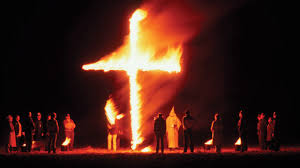
But Paul.  What about these guys, the ones in the pictures?  What about people who spew hatred and evil?  What about people who attack the innocent, just because they are different in one way or another?   I imagine you all know that when Westboro Baptist Church is expected to show up, one of two things usually happens.  If if it a funeral, a group of people - either people wearing giant angel wings or a group of veterans - will act as a barricade so the family doesn’t have to deal with the ugliness.  If it is another sort of event, people show up to peacefully counter-protest with silly signs like, “God hates signs.”  They have practically become poster children for misplaced rage.   In fact, there is a meme running around on the internet that says, “Live your life in such a way that Westboro Baptist wants to picket your funeral.”  

And the ones in the white robes, burning the cross?  Well . . .  They can’t be made fun of.  But like the members of Westboro Baptist Church, they firmly believe they are right in believing and speaking and acting the way they do.   Many consider their actions to be evil, but Paul says,”Don’t pay back anyone for their evil actions with evil actions, but show respect for what everyone else believes is good.“ and “Don’t be defeated by evil, but defeat evil with good.”

Note, please, that Paul doesn’t say “Don’t get angry.” Nor does he say, “Don’t protect yourself from those who harass you, or do evil actions.”  He says, “Don’t try to get even. Leave revenge to the Lord.”  He says, “If possible, to the best of your ability, live at peace with all people.”    

And then he says what I think is the coolest thing ever.  “If your enemy is hungry, feed him; if he is thirsty, give him a drink. By doing this, you will pile burning coals of fire upon his head.”   That’s genius. That makes it feel like you are getting revenge without doing anything wrong!   I’ve heard people say that when someone did them wrong in one way or another, they would just smile.  And every time they saw that person, they would smile.  The other guy would then spend his time watching his back, waiting for the revenge to happen. And of course, that  was the revenge.  Which may or may not be what Paul had in mind… But it is what the Samaritan did, stopping to help a Jew, an enemy, and even putting him up in an inn, spending his own money to help him recover from his injuries.

What Paul does here is take Jesus’ teachings about loving your enemies and give us concrete examples of how to do that.  And to answer the person in that cartoon asking whether Jesus meant the Romans….Yes.  Yes, he did.  He meant the Romans and the guy who cheated you on that car he sold you, and the Klan, and the people who talk bad about you, and anyone you might consider “enemy.”  

Repaying evil with good is fighting fire not with fire, but with water.  Sometimes a fire break, removing all the possible fuel in the path of a fire is necessary to keep the fire from spreading further.  That way the fire burns itself out due to lack of fuel.   Likewise, it’s really hard to keep fighting with someone when they won’t fight back.  Turning the other cheek, refusing to respond with anger to anger, finding ways to do good in response to the evil being done by others, that is what Paul says we need to do.  That is what Jesus means when he says, “Love your enemy.”   Even the Romans.  Even the Klan.  Even religious people whose understanding of God causes them to hate you.  

Love is wanting the best for others regardless of how they behave or how they treat you.  Love is caring for others when they need care, no matter who they are.  Love is refusing to allow someone else’s anger and hatred spark yours.  When you hear evil, respond with good.  When you hear hateful speech, respond with love.   Love one another, even your enemy.  Especially your enemy, cause it’s easy to love your friends, and being a Christian isn’t supposed to be easy. 


************************